The eufy sets off, the camera recognizes the lawn, the first passes look neat—then suddenly a section is missing from the map behind the flower bed, the front garden gets mixed up with the back garden, or the robot stops in front of a closed gate and doesn’t know what to do. Exactly these kinds of situations keep showing up in user reports about the eufy E15, eufy E18, and now also in questions about the new eufy C15. The devices can do a lot, but they’re not miracle boxes for every garden.
With its mowing robots, eufy takes a different approach than classic wire robots or RTK devices: the E15, E18, and C15 models work wirelessly with camera-based Vision navigation. That’s attractive for many gardens because no boundary cable needs to be laid and no RTK antenna has to be aligned. In practice, however, it’s not only the advertised square meter coverage that matters, but the combination of area, edges, gates, shadows, narrow passages, uneven ground, app maturity, and blade wear.
As CUT GUARD, we manufacture and test cutting disc and mowing disc for mowing robots ourselves. That’s why, when looking at a model, we don’t just focus on app features, but also on how the robot works underneath: How much grass collects on the disc? How evenly is it cut? How often do you need to change blades? Anyone who has a eufy running or is preparing a purchase will find suitable replacement and tuning solutions in our overview for cutting discs for eufy mowing robots, especially when the cut pattern becomes frayed after a few weeks or the original mowing disc no longer runs cleanly.
E15, E18 and C15 explained briefly: Which lawn size are they intended for?
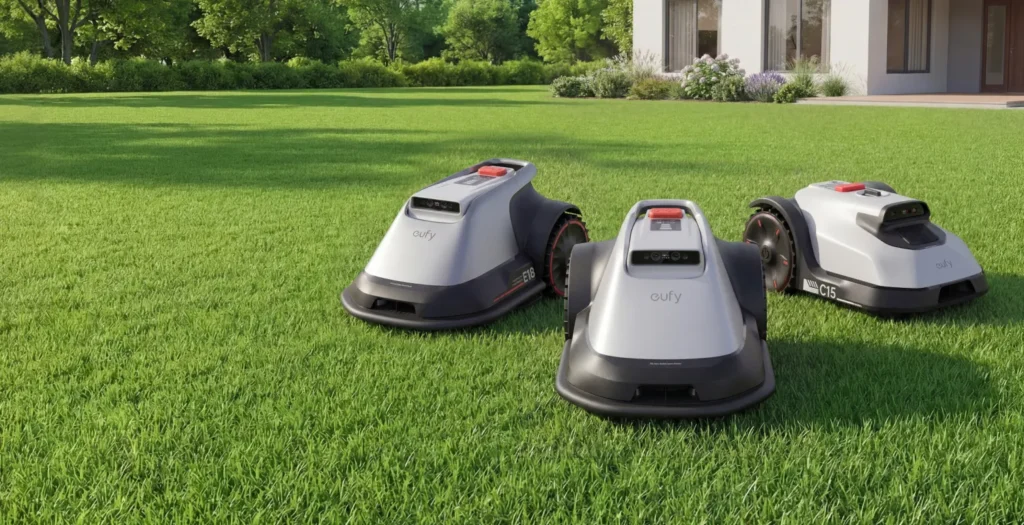
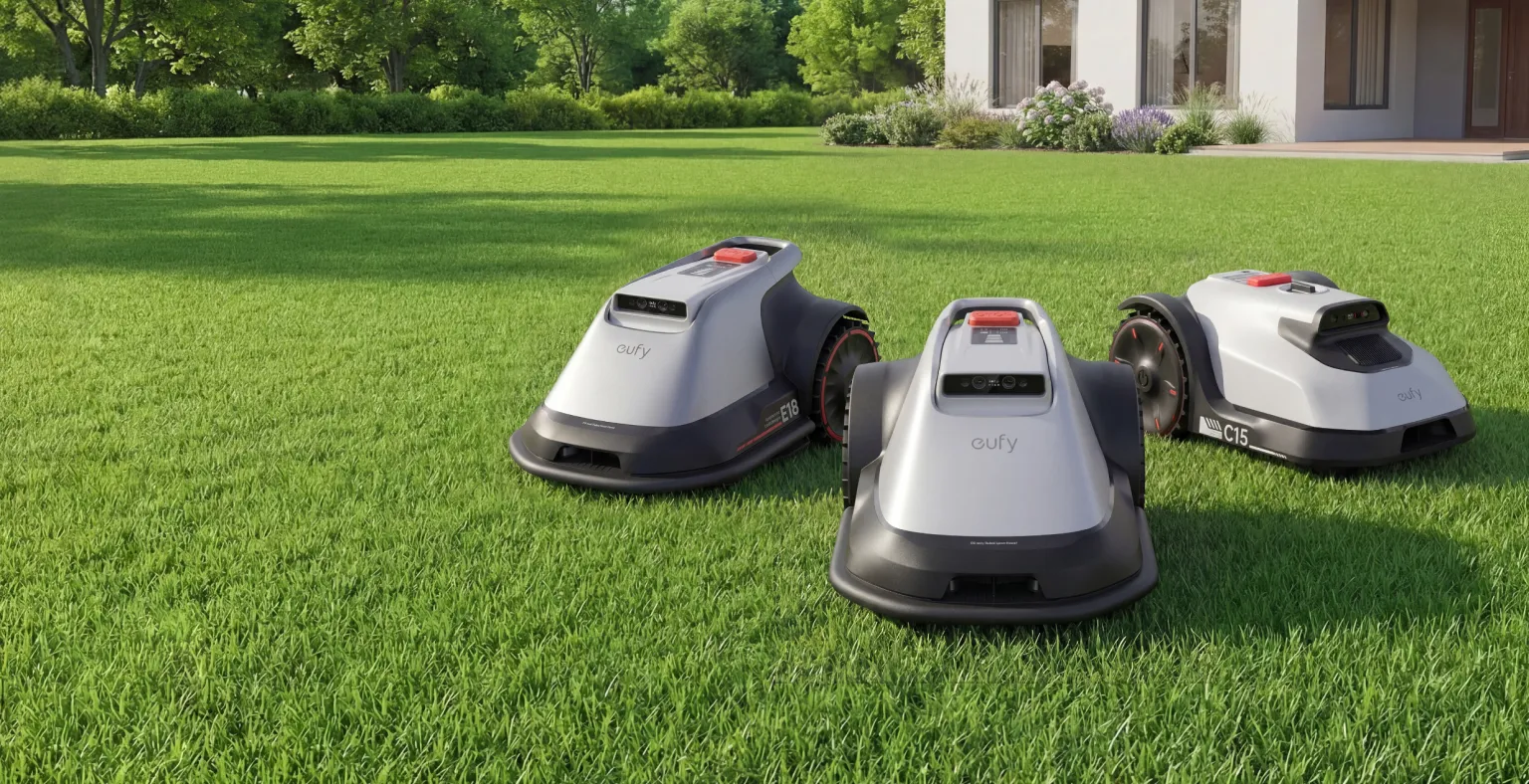
The three eufy models look very similar at first glance: a flat design, a camera module at the front, wireless setup, an app map, and systematic mowing. The difference mainly lies in the intended area, the reserve capacity, and a few practical details.
| Model | Manufacturer positioning | Cutting width / cutting height | Navigation | Strengths in practice | Weaknesses in practice |
|---|---|---|---|---|---|
| eufy C15 | small gardens, approx. 200 to 500 m² | approx. 180 mm / 20 to 60 mm | TrueVision, Vision-SLAM | compact entry-level, interesting for small urban gardens | still limited long-term experience, less reserve than E15 |
| eufy E15 | up to approx. 800 m² | approx. 203 mm / 25 to 75 mm | Vision navigation without wire and without RTK | a good middle ground for simple to medium-sized gardens | mapping and edges may require rework |
| eufy E18 | up to approx. 1,200 m² | approx. 203 mm / 25 to 75 mm | Vision navigation without wire and without RTK | more reserve for larger areas | large gardens take time—plan for charging breaks |
What matters is the actual lawn area, not the property size. Many buyers clearly overestimate their mowing area. A 900 m² property often has only about 350 to 550 m² of real lawn after accounting for the house, terrace, driveway, flower beds, paths, and sheds. Then an eufy E15 can make more sense than an eufy E18, even if the property looks large on paper.
Does the eufy E18 really handle 1,200 m²?
Yes, the eufy E18 is designed for larger areas—but 1,200 m² doesn’t mean the entire garden is finished in a single afternoon. This point is frequently discussed in user reports. The robot mows for a certain amount of time, then returns to charge, waits until the battery has enough charge, and continues later. Also: Vision systems usually mow more reliably when there is sufficient light. If you only allow short mowing windows, the real area performance is reduced even further.
A user with roughly 1,200 m² of mapped area reported, in essence, that the E18 needs closer to two full days for the entire area due to charging pauses and daylight windows. That’s not a complete failure, but a different expectation: the eufy E18 is more of a regular lawn maintainer on large areas than a classic mower that tackles tall grass once a week in a single pass.
With the eufy E15, the same principle applies on a smaller scale. The advertised up to 800 m² should be understood as an upper limit. For 300 to 500 m² of actual, well-defined area, the E15 typically has significantly more room to spare. However, at 750 m² with multiple zones, narrow passages, damp corners, and long return trips, it can noticeably reach its comfort limit.
Why having a safety margin is more important than the pure square meter figure
- Charging pauses: Every trip back to the station costs time, especially in long gardens.
- Grass growth: If the robot doesn’t drive regularly, the grass gets too tall and the mowing becomes less consistent.
- Obstacles: Toys, trees, flower beds, garden furniture, and narrow passages slow down the process.
- Damp areas: Soft ground and wheel ruts can trigger rescue missions.
- Mapping corrections: Especially at the beginning, the map often needs observation.
A workshop rule of thumb: Don’t buy based on property size—buy based on the actual mowing area plus a safety margin. A robot at its limit doesn’t mow more comfortably—it just runs longer and needs more supervision.
Mapping without boundary wire: brilliant – but not worry-free
The big appeal of the eufy series is clear: no wire, no RTK antenna, no tedious cable repair after scarifying. The robot orients itself visually, creates a map, and works with virtual boundaries. For simple, flat, and well-enclosed gardens, this can be very convenient. Many users report that the initial setup starts impressively quickly and that the mower, once properly configured, reliably follows its routes.
The most common pain point, however, is also mapping. In forums, people complain that partial areas are not recognized right away, that map editing feels too rough, or that when errors occur, only deleting and rebuilding the map helps. Some users would like a clear remap function, more precise zone tools, and greater control over how the robot re-mows areas it missed.
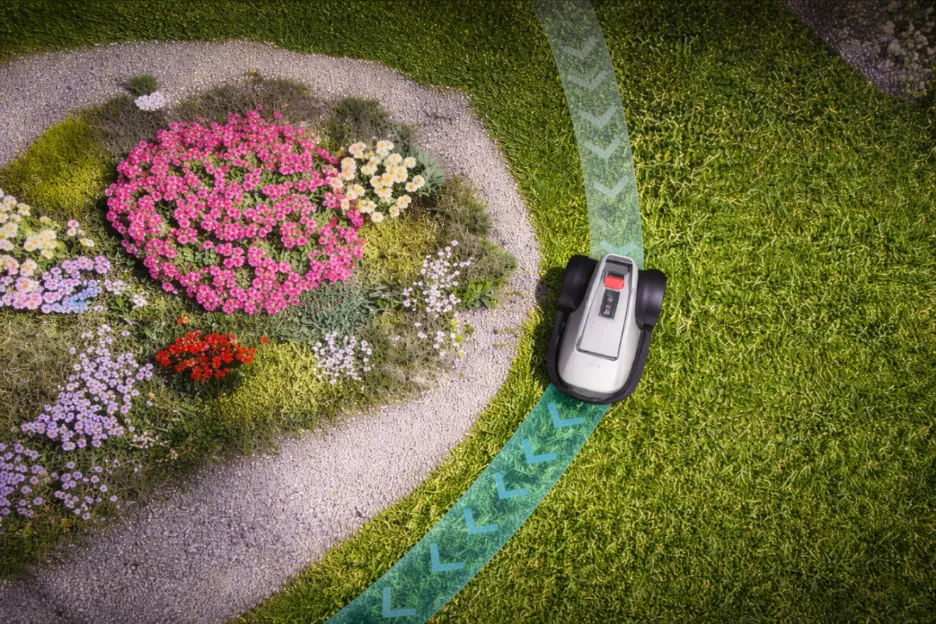
Open properties, road edges, and unclear transitions are especially tricky. A wire robot has a physical electrical boundary. A vision robot has to understand what is lawn, path, flower bed, road, or neighboring area. This works well in many situations, but not always. If the app position and the real position diverge, or if the robot loses orientation during “Locating,” an open edge next to the road becomes a risk. For gardens like these, we always recommend physical barriers, clean lawn edges, or clearly defined no-go areas.
How well do multi-zone areas, gates, front gardens, and back gardens work?
Multi-zone gardens are the point where eufy E15 and eufy E18 move from “runs smoothly” to “needs planning.” Many German gardens are not made up of one large rectangular area, but rather a back garden, front garden, a narrow passage, a terrace, a walkway, a fence, and a gate. In user reports, exactly these questions come up again and again: Can the robot pass through a gate? What happens when the gate is closed? Will two areas be separated cleanly? Do you need a second station?
If two lawn areas are permanently connected and the connecting path is wide, flat, and clearly recognizable, it can work. It becomes critical when a gate is sometimes open and sometimes closed. One user reported that two zones separated by a fence were merged in an unfavorable way by the software. For the robot, it then looked like one logical area, but in reality a fence was in the way.
Our practical recommendation: If the front and back gardens are separated by a gate, you shouldn’t just ask whether the robot can theoretically drive through. What matters is whether everyday use fits. Is the gate reliably open during mowing time? Are there children or pets in the garden? Does the mower have to cross paving stones, gravel, or a narrow passage? If you have to move the mower manually or supervise it regularly, a cordless robotic mower quickly loses its comfort advantage.
Remember: An eufy without a boundary wire still needs clear garden logic. The more gates, separate islands, and narrow paths there are, the more important a proper setup becomes—or a second device.
eufy E15: Who is the mid-range mower best for?
In our view, the eufy E15 is the most interesting all-rounder in the series. It’s a good fit for small to medium-sized gardens that aren’t completely maze-like and have a real mowing area clearly below the 800 m² limit. Many positive experiences come from flat, well-defined gardens where, after the initial phase, the robot drives regularly every day or every other day.
The eufy E15 really shines when expectations are realistic: it’s meant to keep the lawn consistently short, not to tackle tall grass once a week. It needs clear edges, a sensible station corner, as little soft ground as possible, and some observation at the beginning during mapping. Reviews often mention that the mower itself works cleanly, while the app and mapping features still have room for improvement.
When changing the blade, you shouldn’t wait to touch the eufy E15 until the cutting pattern turns gray and frayed. Small blades lose sharpness quickly with frequent operation, especially in dry grass, sandy ground, or with many edge passes. If you use a 9-blade cutting disc for the eufy E15, you’re not aiming for more motor power, but for a finer, more even cutting pattern and a cleaner distribution of the cutting points.
Anyone who wants to go deeper into setup, mapping, edge behavior, and blade practice will find a more detailed assessment in our practical check of the eufy E15 and E18 from a maintenance and cutting-pattern perspective.
eufy E18: More headroom, but not a free pass for complicated gardens
The eufy E18 isn’t simply “the better E15,” but the larger version for more area and more reserve. It makes sense when the actual lawn area is more in the range of 700 to 1,000 m², or when short mowing windows, longer reverse trips, and multiple areas require additional capacity. If, on the other hand, you only have 350 m² of lawn but a large property, buying the E18 likely means getting more mower than you actually need.
Many users praise the hardware of the E18, the cutting image, and the easy basic installation. At the same time, for larger areas, people more often talk about mowing time. Stopping, turning, charging, resuming, and driving over already mowed lanes again costs time. This is normal for systematic robots, but it stands out when you watch the robot constantly. One user put it roughly like this: If the map and mowing rhythm match, it does a good job—one just shouldn’t evaluate every single driving decision.
For the eufy E18, blade wear is the same as for the E15, but often with more runtime per week. Large areas mean more meters on the blade, more contact with edge areas, and more plant debris on the mowing disc. In our tests, one thing becomes clear: regular cleaning underneath the disc and timely blade replacement bring more than setting the cutting height too low. If you mow constantly at the minimum height, you increase the load and, on uneven ground, often even worsen the result.
eufy C15: A compact entry model for small gardens—with little long-term experience
The eufy C15 is the new compact model for 2026 and is aimed at smaller gardens. Officially, it is more in the range of 200 to 500 m². It also uses Vision navigation, but it’s designed smaller: a narrower cutting width, a lower cutting height range, and less reserve than the E15 or E18. For a simple city garden with clear edges, little slope, and a manageable area, this can fit very well.
At the same time, one should be honest about the C15: there are still significantly fewer reliable long-term experiences than with the E15 and E18. With newer models, weaknesses often only become apparent after a few weeks—such as with mapping, damp corners, returning to the charging station, app updates, edge mowing, and blade wear. If you buy early, you get an exciting concept, but you also take on part of the software maturity phase.
With the C15, the price difference compared to the E15 is particularly important. If the eufy C15 is significantly cheaper and the garden really stays small, that makes sense. If the eufy E15 is on offer for only a little more, many users rightly ask whether the additional area reserve isn’t the better decision. Especially for the front and back garden, a single small robot can quickly become impractical.
Even the small C15 benefits from sharp blades and a clean mowing disc. If, after a few weeks, the lawn no longer looks cleanly cut but rather torn or frayed, it’s worth taking a look at a suitable 7-blade cutting disc for the eufy C15, because small mowing robots show a gray cutting pattern particularly quickly with dull blades.
For buyers who are specifically considering the small entry-level mower, we’ve prepared the eufy C15 guide for small gardens—focused on sensible areas, boundaries, and the question of when the E15, despite its higher price, offers the better reserve.
Edges, flower beds, and fences: where manual work still remains
Edges are a recurring issue with eufy. Many users are satisfied with the standard cut, but complain about leftover strips along walls, fences, garden border edging, or tight corners. This isn’t a problem unique to eufy—it affects almost all robotic lawnmowers: For safety reasons, the blade does not sit all the way on the outside. Depending on the housing, boundary logic, and edge construction, a strip may remain.
With eufy, there’s also the fact that some users find edge driving to be not flexible enough. If the robot always drives along the edge in a similar direction, the grass can be permanently laid in one direction. Then the edge looks untidy despite regular mowing. If you expect perfect edges, you should check carefully before buying how many walls, fences, garden stones, and sharp inside corners are in your yard.
Our workshop tip: Make the edge robot-friendly before blaming the robot. A level mowing edge made of stone that the robot is allowed to drive over easily reduces rework significantly. A vertical fence directly next to the grass area almost always produces leftover strips. That’s where the trimmer remains part of reality even with a good robotic lawnmower.
Software, app, and updates: What users are currently criticizing
The hardware of eufy mowers is rated more favorably than the software in many user reports. The main criticisms are about map editing, zone logic, unclear continuation after charging pauses, app dialogs, and firmware-related issues. Some users report situations where the live camera or app prompts were not handled properly. Others want more precise progress data and more manual control over zones.
This is not unusual with young cordless lawn mowing robots. The devices rely heavily on the app, firmware, cloud functions, and local detection. An update can solve a problem, but it can also introduce new quirks. That’s why, before buying, you shouldn’t just read the technical data—you should also check how actively the manufacturer updates and whether users report real improvements after updates.
WLAN, LTE, and remote access are also common sources of uncertainty. Many buyers want to know whether the robot needs WLAN throughout the entire garden or only at the station, whether LTE is necessary for mowing, and whether ongoing costs are involved. Practically speaking, you should distinguish between: setup, app control, updates, remote access, and anti-theft protection—these are not the same as the actual local guidance for mowing. Still, a stable connection at the station is useful, because that’s where updates, status messages, and return logic come together.
Key takeaway: With vision-based mowing robots, software is not an accessory—it’s part of the mowing system. If you have a complex garden, you should take update readiness just as seriously as the battery and cutting width.
Which eufy fits which garden? Specific buying recommendation
Buy the eufy C15 if …
The eufy C15 is suitable for small, simple gardens with clear boundaries, little slope, and a manageable mowing area. It’s ideal for a city garden where the robot doesn’t have to pass through multiple gates, travel long distances, or navigate complicated side zones. Be cautious if the price is close to the E15 or if real long-term experience is important for your purchase decision.
Buy the eufy E15 if …
The eufy E15 is the best choice for many typical home gardens. It’s a good fit if the actual lawn area is clearly below 800 m², the garden is well-defined, and the edges aren’t extremely demanding. It’s also a sensible option if you want a bit of buffer, but don’t need a large E18.
Buy the eufy E18 if …
The eufy E18 is worth it for larger lawn areas, longer mowing windows, and when the robot is allowed to drive regularly. It’s the better choice if the E15 would have to run permanently at its limit. However, it doesn’t replace good garden layout: many separate zones, closed gates, deep ruts, and open road boundaries remain critical.
None of the three is ideal if …
- the garden is very winding and has many narrow passages,
- the front and back garden are separated by gates that are constantly kept closed,
- the lawn area borders an open road,
- you expect perfect edges without a trimmer,
- the ground is soft, full of holes, or heavily churned up,
- you only want to let the robot run infrequently and expect tall grass.
Frequently asked questions
Does a eufy lawn mower robot need WLAN throughout the entire garden?
In most cases, stable WLAN at the station is more important than seamless WLAN on every square meter of lawn. For the app, updates, and status messages, the connection at the dock should be reliable. For long gardens or thick walls, a repeater can still be useful.
Is LTE on the eufy E15, E18, or C15 required for mowing?
LTE is primarily interesting for remote access, status, and theft protection, not as a classic “mowing motor.” Before purchasing, check whether the respective model in your market has an integrated or optional module and whether additional costs may arise later. The equipment can vary depending on the country and package.
Do I still need to cut lawn edges myself?
Yes, at many fences, walls, and garden bed edges, follow-up work is still necessary. A level, mowable edge significantly reduces the remaining strip. If you expect perfect edges, you should evaluate eufy critically, especially in terms of its own edge design.
How often do you need to change the blades on eufy lawnmowing robots?
In practice, you should check the blades every few weeks and replace them immediately if the cut pattern looks frayed. Sandy ground, lots of edge travel, dry grass, and large areas accelerate wear. A gray lawn sheen is often a sign of dull blades, not incorrect navigation.
What happens in the rain?
The eufy models are weather-protected, but they should not work unnecessarily on wet grass. Damp grass sticks more strongly to the mowing disc, puts more strain on the blades, and can leave marks on soft ground. For a clean cut pattern, dry grass or only slightly damp grass is better.
Conclusion: eufy is strong for simple gardens – but plan honestly
eufy E15, eufy E18, and eufy C15 are exciting because they make cordless mowing without an RTK antenna and without a boundary wire easy to access. That’s exactly their biggest advantage. If you have a flat garden with good boundaries and you give the robot time at the beginning for mapping and corrections, you can get a lot of relief.
The most important decision is not “E15 or E18 based on property size,” but: How large is the actual mowing area? How complex are the zones and gates? How clean are the edges? How much runtime can the robot have per week? For small, simple areas, the C15 is interesting; for many typical gardens, the E15 is the best compromise; for larger areas, the E18 is the logical reserve.
From a cutting perspective, the same applies to all three: a good robotic mower only stays good if the blades, blade plate, and underside are maintained. Sharp Klingen, a clean mowing disc, and a realistic cutting height often deliver more in everyday use than the next app gimmick.
Comments