The eufy E15 and eufy E18 are of interest to many garden owners because they operate without boundary wires and without a classic RTK antenna. This is exactly what makes the models exciting for anyone who does not want to lay a wire and is looking for a rather simple, app-controlled solution. At the same time, user reports from forums and Reddit clearly show: These robotic mowers do not perform equally well in every garden.
From the perspective of Messerscheibe24, it is important: We do not sell robotic mowers, but accessories and spare parts such as cutting discs, mowing plates, and replacement blades. Therefore, this article is not about marketing promises, but about the practical question of how the E15 and E18 behave during setup, mapping, mowing, at edges, and regarding blade wear.
The short version: For smaller to medium-sized, clearly defined lawn areas, the eufy E15 and E18 can be a very pleasant solution. However, those with open property boundaries, many tight spots, several separate zones, holes, ditches, or very high expectations for perfect edges should take a closer look before purchasing.
eufy E15 vs. E18: Which model is really worth it for which lawn area?
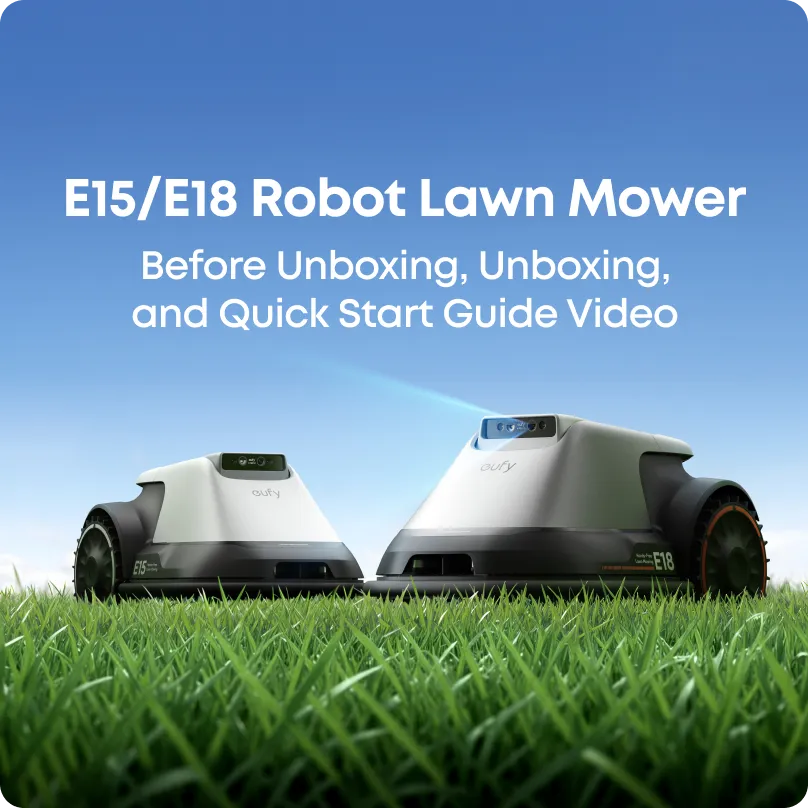
The most important difference between eufy E15 and eufy E18 is the advertised area performance. The E15 is aimed more at smaller to medium gardens, while the E18 is for larger areas. In practice, however, one should not read these manufacturer values as a guaranteed daily performance.
Many users report that the E15 can work well at around 200 m² with obstacles, but it does require a whole day including charging breaks. At around 350 m², it is already considered somewhat tight in user reports. The E18 has more reserve, but it is also not a magic device when the garden is heavily angled or consists of several separate areas.
A rule of thumb from the robotic lawn mower practice is: A simple, rectangular lawn without many obstacles comes closer to the manufacturer’s specification. As soon as zones, bottlenecks, paths, trees, play equipment, beds, open boundaries, or slopes are added, one should plan for a class larger. This is especially true if the robot is to maintain reliably on a weekly basis, rather than just occasionally.
| Model | Manufacturer Area | Cutting Height | Navigation | Strengths in Practice | What to Watch Out For? |
|---|---|---|---|---|---|
| eufy E15 | up to approx. 800 m² | 25–75 mm | Camera / Vision System, wireless, no RTK | good choice for smaller, clear lawns; easy basic setup | little reserve at 300–350 m² with obstacles; plan for charging breaks |
| eufy E18 | up to approx. 1200 m² | 25–75 mm | Camera / Vision System, wireless, no RTK | more area reserve; interesting for larger or multiple zones | Mapping and app logic remain crucial; do not overestimate edges |
Those who fluctuate between E15 and E18 should not decide solely based on square meters. More important is the question: How clear are the boundaries? How many objects are on the lawn? Are there narrow paths or separate areas? Does the robot need to do a little maintenance every day, or should it mow large areas infrequently?
Setup & Mapping: When does TrueVision work well – and when does it become annoying?
The simple basic setup is positively mentioned in many user reports. Unpack, place the base station, connect the app, start mapping – this first step feels significantly more pleasant for many than with a traditional lawn mower with boundary wire. Especially those who already use vacuum robots or other eufy devices usually find their way around quickly.
It becomes more challenging not during registration, but in accurately capturing the garden. The E15 and E18 work with cameras and algorithms. This is convenient as long as the lawn is clearly separated from paths, beds, walls, fences, or edges. Open property boundaries to neighbors, on the other hand, are a typical problem point.
Many users report that automatic mapping works well with clearly defined areas. However, with open transitions, flat paths, complex shapes, or multiple sub-areas, one must work with virtual boundaries, no-go zones, and subsequent corrections. Those who hope the robot will immediately understand an open lawn edge accurately should be cautious.
Prepare open boundaries rather than just observe
In experience reports, it is often recommended not to leave open property boundaries to automatic mapping. Once the robot captures an incorrect area, correcting it later can be cumbersome. It is more practical to set clear virtual boundaries beforehand or to make the area physically clearer.
Typical aids include lawn edging stones, low bed borders, clearly recognizable paths, or neatly defined no-go zones. Especially with neighboring areas without a fence, one should take their time. Half an hour of clean mapping saves many interrupted trips and frustration later on.
Multiple zones work – but not always self-explanatory
Several users report that they were able to set up three or more zones. Nevertheless, questions keep arising: How are paths between zones defined? Which zone is mowed first? What happens if a path is blocked? Can a car in the driveway block the way to the next area?
The answer is: It can work, but it requires careful setup. Narrow paths, open gates, and transitions over paved areas must be designed so that the mower reliably recognizes them and does not suddenly drive into an incorrect area. Those with many zones should not leave the first mowing run unattended.
Zones, schedules, and app: The biggest weakness in everyday life?
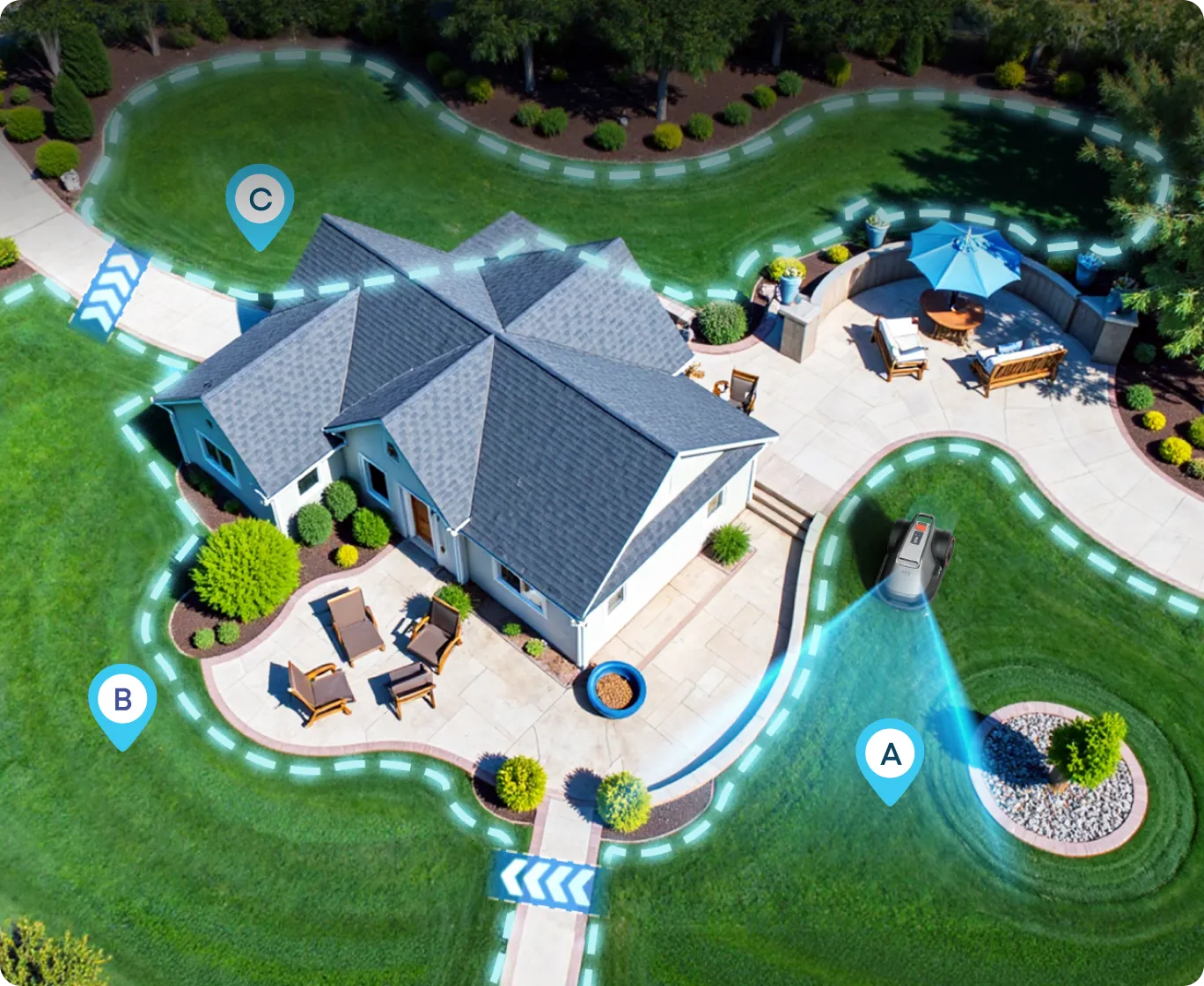
The app is the point where opinions diverge the most. The basic operation seems simple, but many users describe scheduling and zone control as still quite basic. Especially with multiple mowing areas, users wish for more detailed options and clearer documentation.
In forums, it is often criticized that it is not always clear which zone is being mowed when. Some users have the impression that the mower decides for itself what fits at the moment. For a simple garden, this is often not a drama. However, with multiple zones, limited mowing windows, or tight battery reserves, it can be annoying.
Resuming after charging pause: not always clear
A recurring theme is the behavior after a charging pause. Some users report that the robot continues to work after charging as long as the time window is still active. Others describe exactly the opposite: The E15 drives to the station with a dead battery, does not start cleanly afterward, or does not reliably save progress.
This is an important point in everyday life. If a lawn mower robot cannot cover 200 to 400 m² in one go, the resuming after charging must work reliably. Otherwise, in the worst case, it starts over again while other areas remain untouched. Anyone setting up an E15 or E18 should consciously observe this behavior in the first week.
Documentation and Support: Room for Improvement
Several users wish for a better explanation of the app logic. What happens when the battery is low? In what order are zones processed? Which setting affects edge distance, paths, or driving patterns? If such points are not well documented, it quickly creates the impression that the mower operates illogically.
There are also occasional reports of frustrating support experiences. This is not proof of a fundamentally poor service system, but a hint: Those with a complex garden should not assume that every special problem will be solved immediately. It is better to realistically assess the area before purchase.
Cutting Pattern, Edges, and Rework: How Much Manual Work Remains?
In terms of cutting pattern, E15 and E18 perform well in many user reports. Users praise the even area maintenance and report that the lawn looks significantly better after regular runs. This is exactly where the strength lies: The robot continuously removes small amounts of grass and keeps the area consistently short.
With edges, the situation is more nuanced. eufy promotes strong edge handling, but in practice, stripes often remain along walls, beds, obstacles, and tight spots. Some users are satisfied with this, while others have to manually trim several centimeters around objects. This is normal for many robotic mowers, but should be factored in when purchasing.
The E15 and E18 are therefore more maintenance mowers than a complete replacement for any trimmer. Those expecting absolute edge perfection will likely be disappointed. Those who accept that a quick trim in difficult areas is necessary every one to two weeks will evaluate the models more realistically.
Blade condition greatly influences the cut quality
A clean cut depends not only on navigation and motor but also heavily on the blades. Dull or damaged blades tend to tear grass blades rather than cut them cleanly. This is evident from frayed tips, yellowing grass edges, and an overall more uneven mowing pattern.
Especially with camera mowers like the eufy E15 and E18, it is worth regularly checking the underside. Wet grass, dried cuttings, and small stones can clog the blade disc and blade area. Those who frequently let the mower run should not wait to change the blades until the cut quality is visibly poor.
For the original-like setup, a 6-blade cutting disc is interesting if the existing disc is worn or damaged. If you want a bit more cutting contact, you can check an alternative 7-blade cutting disc. For users who place a high value on a fine cutting pattern, a precise mowing plate like the 9-blade cutting disc is recommended.
Important: More blades do not replace a clean garden setup. A better cutting disc can improve the cutting pattern, but it cannot solve incorrectly set boundaries, deep holes, or blocked paths.
Typical garden problems: holes, ruts, narrow paths, cars, and open gates
A robotic mower without boundary wire initially seems like it can navigate anywhere flexibly. In practice, even an eufy E15 or E18 needs a prepared garden. Deep holes, ruts, channels, and soft spots where the front caster or wheels can get stuck are particularly problematic.
One user describes that his E18 generally provides good hardware and a good cutting pattern but got stuck in deep ruts. The interim solution was small no-go zones around these areas. In the long term, it is better to fill and level such areas.
Narrow paths also deserve attention. When the mower needs to travel between two lawn areas over slabs, a driveway, or a narrow passage, this path must remain reliably clear. A parked car, a closed gate, or scattered toys can disrupt the entire logic.
Clean up before the first mapping
Before the first mapping, the lawn should look as it will mostly look later. Garden chairs, toys, hoses, mobile garden borders, and other obstacles should be removed or deliberately planned as no-go areas. The cleaner the starting condition, the less rework in the app.
Special caution is advisable with open gates. If a gate is open during mapping but later sometimes remains closed, the robot may not be able to use a planned path. Conversely, a permanently open gate can cause the mower to recognize areas that should not actually be mowed.
Battery, charging breaks, and area performance: Why “up to 800/1200 m²” does not mean “finished quickly”
The area specifications of robotic mowers are always ideal values. With the eufy E15 and E18, users report that a complete mowing cycle can take significantly longer than expected depending on the garden. An E15 can work well with around 200 m² with obstacles, but still be busy for a whole day including charging breaks.
This is not automatically bad. Robotic mowers are designed for regular maintenance, not for quick mowing like a traditional lawn mower. It only becomes problematic when the garden is so large or complex that the robot is constantly playing catch-up and never really finishes.
For multiple zones, it is advisable to plan generous time windows. If the mower is only allowed to run for two hours in the evening, but one zone takes significantly longer due to charging breaks, uneven results will occur. A better approach is a rhythm where each zone is regularly attended to without time pressure.
Battery and Long-Term Concerns
Occasionally, users report battery issues after prolonged use or concerns about spare parts supply and app maintenance. Such individual reports should not be overvalued, but also not ignored. Especially with new robotic mower series, the question of how well updates, accessories, and spare parts will remain available in the long term is important.
For ongoing maintenance, blades, screws, cutting discs, and cleaning are the obvious points. The battery is more expensive and complex. Those who want to use their robot for a long time should not leave it unnecessarily in direct heat, keep the station clean, and regularly remove grass clippings from the underside.
User Conclusion: Who E15/E18 is Suitable For – and Who Should Keep Their Distance
The eufy E15 is best suited for smaller, well-defined gardens with few obstacles and a simple zone structure. If you want to maintain about 150 to 250 m² regularly, the E15 offers an interesting solution without the need for wiring. For areas of 300 m² and more, one should carefully examine how complex the area really is.
The eufy E18 is the better choice when more reserve is needed. This applies to larger lawns, multiple zones, or gardens where the mower requires longer travel times. Nevertheless, it remains true: the E18 also does not solve poorly prepared areas. Open boundaries, difficult edges, and deep grooves remain issues.
Users should take a step back or at least plan very carefully if they have open neighboring properties, many round flower beds, narrow passages, constantly changing obstacles, or very high expectations for edges. In such gardens, the robot can function, but only with patience, no-go zones, must-mow areas, and regular monitoring.
On the other hand, those who have a clear lawn and are willing to invest a few hours in setup and fine-tuning at the beginning can achieve good care results with the E15 or E18. The technology is impressive, but it requires realistic expectations.
Frequently Asked Questions
Does the eufy E15 or E18 need Wi-Fi throughout the garden?
For setup and communication, the connection at the base station is particularly important. However, user questions often arise about poor coverage in the garden causing problems, especially with app access, status messages, or remote zones. Depending on the property, a Wi-Fi extender or stable network coverage may be advisable.
Can the eufy E15/E18 mow multiple zones?
Yes, multiple zones are possible and are also used by users. The key is that paths between the areas are clearly laid out. If a path is blocked, for example by a car or a closed gate, the robot may not reliably reach the next zone.
Does the mower automatically continue after charging?
The behavior is described inconsistently. Some users report that the mower continues to work after charging as long as the time window fits. Others had issues with the progress not being saved properly. Therefore, this behavior should be tested directly in the first few days.
How well do E15 and E18 mow edges?
On open areas, the cutting pattern is often good. However, grass often remains at edges, obstacles, tight spots, and walls. The E15 and E18 significantly reduce manual work but do not completely replace the trimmer on difficult edges.
E15 or E18: Which model is better?
For smaller, simple gardens, the E15 is often sufficient. For larger areas, multiple zones, or many obstacles, the E18 is the more sensible choice because it offers more reserve. If you are already reaching the limit with the E15, you should not calculate too tightly.
Conclusion: Strong approach, but not a sure thing
The eufy E15 and eufy E18 are exciting robotic mowers for anyone looking to start without boundary wires and without an RTK antenna. The simple basic setup, automatic mapping, and good cutting pattern on suitable areas are praised by many users. This can work very well, especially in smaller, clearly defined gardens.
The weaknesses lie where many modern wireless robotic mowers still struggle: open boundaries, complex zones, unclear app logic, edges, narrow paths, and problematic ground spots. Additionally, there are individual reports about charging pauses, support, and long-term issues.
Anyone buying the E15 or E18 should not consider it a magical fully automatic mower, but rather as a maintenance mower that requires a well-prepared garden. With clean mapping, sensible no-go zones, sharp blades, and regular cleaning, much can be achieved with these devices. Without this preparation, the wireless freedom quickly turns into troubleshooting in the lawn.
Tip: You will find all matching replacement blade discs and mowing plates for EUFY in our overview: Blade discs for EUFY.
Comments