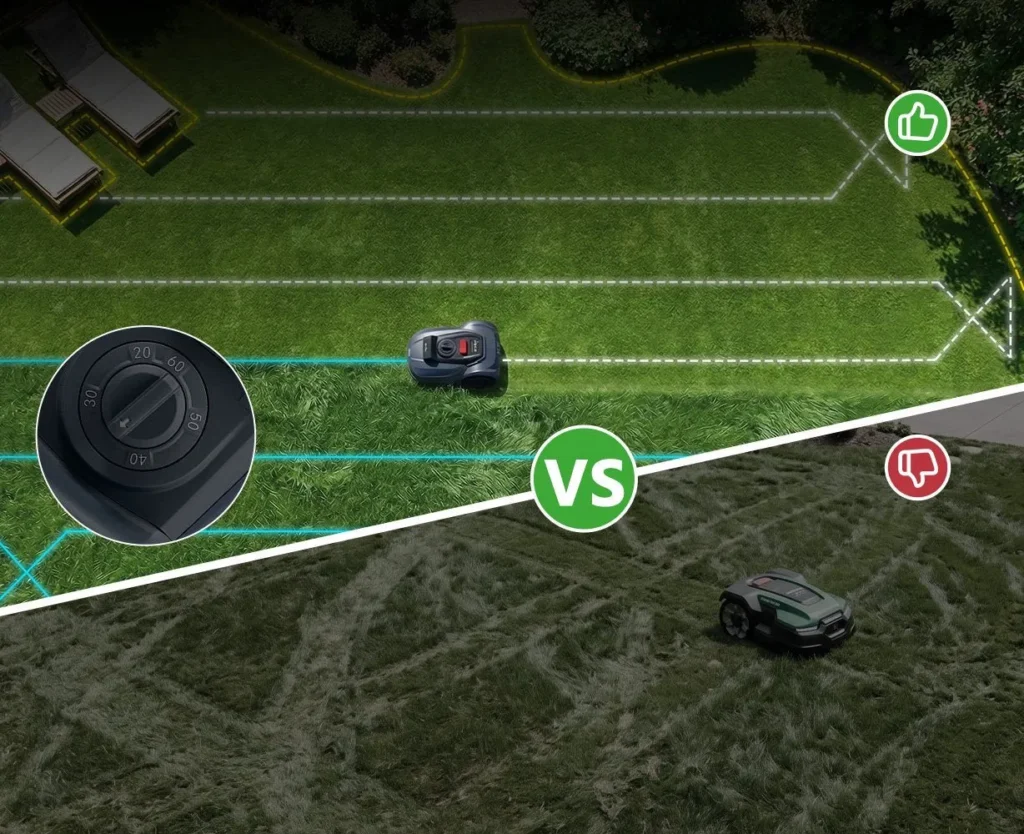
The lawn is small, the old wire is annoying, and suddenly a cheap robotic mower appears that allegedly does without boundary wire, without an RTK antenna, and with automatic mapping: the Natural Expressions Performance 7. But this is also where the frustration of many potential buyers begins. Not because a large number of defects are known, but because there is little solid long-term experience available before purchase. In forums, people argue less about broken motors or weak batteries, and more about the question: Is this a standalone mower, a TerraMow relative, an Eufy-like device—and will I get app updates, blades, and support later?
From a workshop perspective, this is a typical case for a sober assessment. A wireless vision-based robotic mower can save a lot of work in a manageable garden. But it can’t outsmart physics: edges remain edges, narrow curb stones remain narrow curb stones, and a three-blade mowing disc does not sit directly on the outside of the housing for safety reasons. So if you buy the Performance 7, you shouldn’t just look at “500 m²”, “Drop & Mow”, or “AI Vision”, but at garden shape, edge design, the app ecosystem, and wear parts.
What exactly is the Natural Expressions Performance 7?
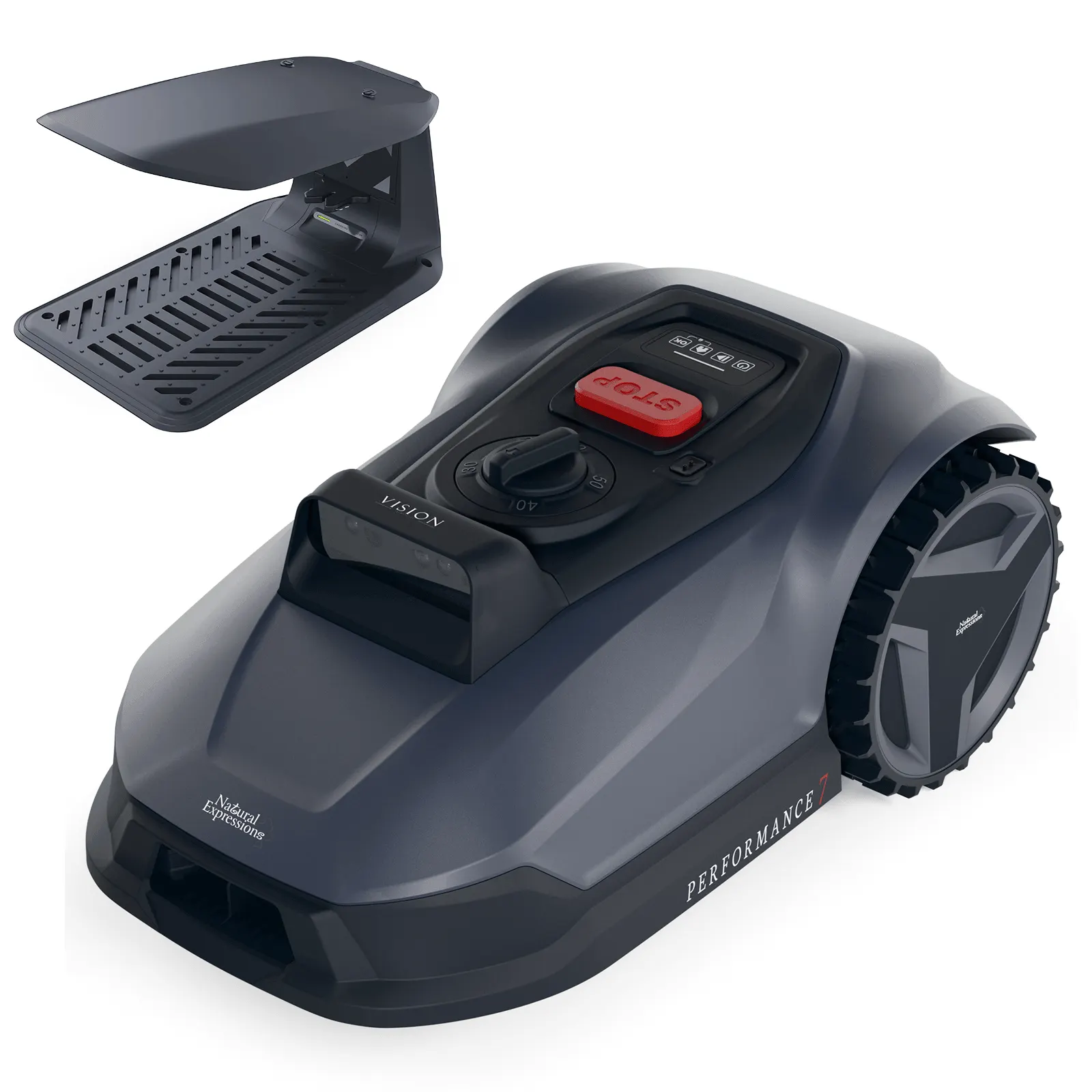
The Natural Expressions Performance 7 is a wireless robotic mower for smaller to medium-sized private gardens. It does not work with conventional boundary wire and also not with an RTK reference antenna in the garden. Instead, it uses camera- or vision-based navigation with automatic mapping. This makes it interesting for users who don’t want to lay cables and also don’t accept an antenna mast next to the terrace.
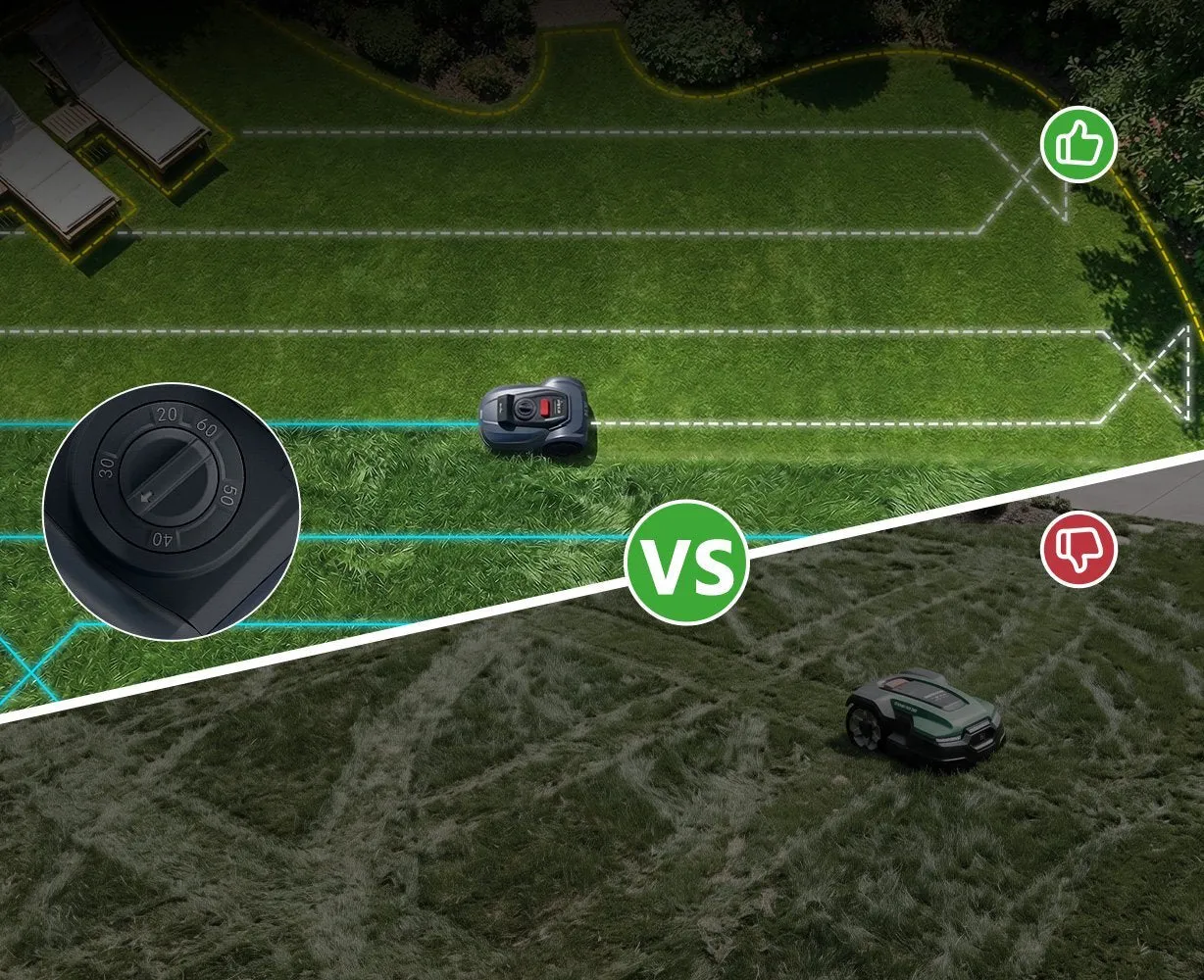
The manufacturer data for this class sound solid: up to about 500 m² of daily output, a 18 cm cutting width, cutting height from 20 to 60 mm, three moving blades on the mowing disc, a noise level of around 56 dB, a rain sensor, an IPX6 protection rating, and multi-zone management. In practice, that means: the mower isn’t aimed at large, wild properties, but at home gardens, townhouse gardens, city gardens, and well-kept areas where the lawn boundaries are clearly recognizable for a camera.
Many user questions currently aren’t about the equipment alone, but about the young market phase. In the robot forum, the Performance 7 has only been discussed more intensively since spring 2026. What stands out is this: so far, there hasn’t been a broad collection of classic negative reports such as “keeps failing to return home,” “the app crashes every day,” or “battery gets weak after three weeks.” That sounds positive at first, but it’s also a risk. With young mowing robots, typical weaknesses often only become apparent after several weeks: after firmware updates, in damp grass, with changing sun positions, in narrow passages, or when multiple zones are supposed to be mowed regularly.
Practical rule of thumb: The Performance 7 is exciting because it works without a wire and without RTK—but the thin base of real-world experience is itself a purchase criterion.
Is the Natural Expressions Performance 7 identical in design to the Eufy C15 or the TerraMow Mini 500?
This exact question comes up again and again in forums. Several users see clear similarities between the Natural Expressions Performance 7, TerraMow devices, TerraMow Mini 500 and Eufy C15. Mentioned among other things are the chunky treaded rear wheels, the front charging port, the shape of the base station, and camera-based navigation. One user also reports that his device runs with the AuraMow app, which further fueled the discussion about licensed builds or a shared technical base.
Here, it’s important to make a clear distinction: “similar,” “related,” “licensed build,” and “identical in design” are not the same thing. Two robotic lawnmowers can share housing parts, platforms, or navigation concepts and still have different app versions, firmware versions, replacement part numbers, support paths, and warranty conditions. That’s exactly what matters for buyers. If a cutting disc, a mowing disc, a wheel motor, or a charging contact unit later needs to be replaced, optical similarity alone won’t help much.
The practical advice is therefore this: before making a purchase, check the app name, the model number, the type plate, the dealer, the warranty processing, and available spare parts. With newer or rebranded devices, it’s not just the purchase price that matters. What’s important is whether, after two years, there are still suitable blades, batteries, wheels, charging accessories, and firmware maintenance available. Especially with mowing robots, we often see in the workshop: the robot itself lasts longer than the initial app hype—but only if wear parts and software remain available.
Real user experiences: What works well?
The available real experiences so far are rather limited, but not worthless. A user in the robot forum describes the setup as significantly more pleasant compared to an Ecovacs Goat G1. In particular, multiple zones are said to have worked more straightforwardly. That fits the concept: the Performance 7 doesn’t want to be set up by long manual boundary tracing, but instead should map as independently as possible.
Even during mowing operation, the feedback is more positive. The same user praises the mower as efficient, quiet, and faster than his previous device. This isn’t a broad long-term test, but an interesting individual report because it comes from a direct comparison in his own garden. Especially on smaller areas, a compact vision mower can play to its strengths: short routes, little installation effort, manageable zones, and no RTK problems caused by buildings or trees.
The price is also discussed positively. In forums and listings, amounts of around 680 to 700 euros including the garage are mentioned. For a cordless robotic mower with camera navigation, that’s attractive. The catch: a low price shouldn’t lead you to buy it for tasks that actually require a larger class of device. If you have 450 m² in a rectangular layout, you can be closer to the manufacturer’s specification. If you have 450 m² spread across five zones, with shadows, a trampoline, dog toys, narrow passages, and long reverse trips, you need more reserve.
The biggest weaknesses and uncertainties
The biggest weak point at the moment isn’t a known recurring manufacturing defect, but the limited base of experience. There are hardly any reliable negative reviews on Amazon.de for the specific model, and only a few real long-term reports. If you want to know how the battery, app, mapping, return to the station, and blade pickup perform after a complete season, there’s currently little material available.
The second uncertainty concerns the app and firmware. User reports mention AuraMow, while at the same time people talk about proximity to TerraMow. For everyday use, this is more than a minor issue. A good robotic lawnmower app determines zones, schedules, no-go areas, map corrections, notifications, theft alarms, and updates. If a device is technically good but the app isn’t maintained properly later on, you notice it first in seemingly small things: the map has shifted, a zone can’t be selected, the return trip was aborted, the connection is only stable via Bluetooth, or a firmware update without a clear description of changes.
Thirdly, the edge-cutting capability is limited. The Performance 7 has no side mowing attachment. Its mowing disc sits under the housing, as with many compact robotic lawnmowers. This is safer, but it means that a strip almost always remains when mowing directly along walls, raised beds, pool decks, fences, and narrow curb stones. If you’ve previously used a lawn trimmer to touch up the edge for 20 minutes every week, you won’t completely get rid of that work.
Fourth, you should read the area specification critically. Manufacturer figures are usually generated under favorable conditions. A simple garden with clear borders, good lighting, and short paths is something different from a maze-like garden with pinch points, shadows, multiple levels, and short permitted mowing windows. More zones don’t automatically mean more performance; they often mean more maneuvering, more return trips, more charging cycles, and more dependence on the app.
Practical rule of thumb: With the Performance 7, you’re not just buying a mower—you’re also buying into a young app and replacement parts ecosystem.
Which gardens is the Performance 7 suitable for?
Natural Expressions Performance 7 should fit well in small to medium-sized gardens that are clearly structured visually. In other words: the lawn is clearly separated from the terrace, flower beds, gravel, paving, or a wall. The station is not placed in a dark, narrow corner. There is enough space to enter and exit. The areas are not constantly covered by toys, garden hoses, branches, or leaves.
It is particularly interesting for users who do not want to lay a boundary wire. Especially for rental properties, newly landscaped gardens, or small rows of townhouse plots, this is a real advantage. Anyone who cannot or does not want to set up an RTK antenna will also find a sensible approach in the Vision concept. In such gardens, simple setup can be more important than maximum off-road capability.
I would be cautious with heavily winding properties, unclear lawn boundaries, frequent changes in shade, narrow passages under 60 cm, steep edges, molehills, deep ruts, and areas clearly above the 500 m² class. Also, very large, wild properties are not its territory. In forums, the Performance 7 is discussed more in the context of smaller gardens and 300 to 500 m²—not as a solution for 1,500 or 2,800 m².
How good is the edge cutting with the Natural Expressions Performance 7?
The edge cut is the point where expectations quickly become too high. Marketing terms like “borderless” or “edge-to-edge” sound like a perfect edge. In practice, however, the mechanics decide: Where is the mowing disc located? How far can the blade safely extend outward? Can the robot drive over the edge? Is there a hard wall or an edge that can be driven over?
With Performance 7, a central mowing disc works with three movable blades. This has proven itself for normal area cutting, but it is not the same as a side-shifted mowing unit. Along walls, raised beds, and fence posts, a strip of uncut grass remains. With wide, even mowing edges, it can come closer, but even then the mapping, the edge pass, and the actual width of the stone edge determine the result.
From our CUT GUARD workshop perspective, we see the same connection with many mowing robots: sharp, freely movable blades improve the cutting appearance on the lawn area, but they do not solve the edge problem if the mowing disc is positioned too far inward by design. If, after a few weeks, the grass looks frayed, gray, or uneven, it’s worth starting by checking the replacement blades and the blade holder. Anyone who is dissatisfied with the original mowing disc or wants a calmer, more even cutting appearance should also take a look at matching cutting discs for mowing robots before questioning the entire robot.
Cleaning is also important. Damp grass likes to collect on the mowing disc, especially with a low cutting height and dense grass growth. When the disc becomes heavy, the blades swivel less well, the motor has to work harder, and the cutting appearance suffers. In such cases, we check first: Are the blades dull? Are they stuck with residue? Can they pivot freely? Is the disc warped or packed with grass? Only after that is it worth troubleshooting in the app or navigation.
Practical rule of thumb: A clean edge cut depends not only on navigation—mowing disc position, blade freedom of movement, and edge design also play a role.
Natural Expressions Performance 7 vs. TerraMow Mini 500 vs. Eufy C15
The comparison comes about because all three devices fall into a similar buyer question: a small garden, cordless, as simple setup as possible, no RTK antenna, and no wire installation. In forums, the Performance 7 is repeatedly mentioned alongside the TerraMow Mini 500 and the Eufy C15. This is helpful for interested buyers, but also confusing, because technical similarity does not automatically mean the same experience.
| Model | Key details in practice | Strengths | Weaknesses / open points | Practical assessment |
|---|---|---|---|---|
| Natural Expressions Performance 7 | Vision navigation, without wire, without RTK, approx. 500 m² class, 18 cm cutting width, three blades | Affordable entry-level, easy setup according to user reports, garage often included in the package | Limited long-term experience, app/firmware future still hard to assess | Exciting for small, clear-cut gardens if the price and availability fit |
| TerraMow Mini 500 | Discussed in forums as a close comparison for small areas | Interesting for buyers who deliberately expect the TerraMow ecosystem | Check availability and the specific differences versus the Performance 7 very carefully | Waiting can make sense if official brand support is more important than an immediate purchase |
| Eufy C15 | Also categorized in the same context as compact vision mowers | Well-known brand name, interesting for simple gardens | Here too, check edge cutting, app features, and real mowing performance | Comparison is worth it if the app ecosystem and dealer structure matter more than the lowest price |
My buying rule of thumb would be simple: buy if the Performance 7 is immediately available, the price is clearly attractive, the garden stays manageable, and you can live with a bit of residual uncertainty in the young ecosystem. Wait or compare if you want maximum clarity regarding firmware, spare parts, app history, and brand support. Especially with mowing robots, the lowest purchase price is not always the cheapest ownership over three to five years.
What role do cutting discs, mowing discs, and maintenance play?
On the Performance 7, there is a classic mowing disc with three movable blades underneath. This is a robust solution for frequent mulching. The blades don’t cut like a heavy sickle blade, but rather with many small cuts. This creates a fine lawn cut as long as the blades are sharp and can swing out freely.
In practice, dull blades are often mistaken for navigation problems. The mower appears to be running normally, but the cut pattern turns gray, ragged, or unsteady. Then you look for the cause in the app, even though it’s actually located at the blade underneath. That’s why, in our CUT GUARD tests, we always focus on three points: blade sharpness, blade mobility, and distance to the disc. A blade that gets stuck by grass residue cuts worse than a slightly used but freely movable blade.
For small gardens, a regular visual check every two to four weeks is usually enough. On sandy ground, with lots of branches, pine cones, fallen fruit, or frequently damp grass, the blades may need to be changed earlier. If you mow multiple zones, you should also make sure the robot comes into contact with hard objects on paving stones, edges, or transitions. This is often noticeable through small chips or bare spots on the blade tip.
Frequently Asked Questions
Does the Natural Expressions Performance 7 need a boundary wire?
No, the Performance 7 is designed as a cordless robotic mower without a traditional boundary wire. It uses camera- or vision-based navigation and automatic mapping. Still, in practice, lawn boundaries must be recognizable; otherwise, the risk of untidy edges or map corrections increases.
Which app does the Natural Expressions Performance 7 use?
User reports mention AuraMow as the app. That’s exactly why discussions in forums focus on a possible technical similarity to TerraMow and potential licensing. Before purchasing, you should check in the App Store, on the type label, and in the manual which app version is intended for your device.
Does the Performance 7 work without RTK?
Yes, the Performance 7 operates without an RTK reference station. This saves setup effort and avoids antenna problems, but it does not replace the need for clear visibility conditions for camera navigation. Difficult shadows, unclear edges, and narrow passages remain relevant points to check in real-world use.
How large can the garden realistically be?
Realistically, the Performance 7 fits best in small to medium, well-organized gardens of up to about 500 m². For complex 500 m² gardens with multiple zones, long reverse trips, and short mowing windows, I would rather plan a reserve or check a larger class. For very large, wild properties, it is not the right choice.
Are there any real negative reviews on Amazon.de for the Performance 7?
At the moment, there are hardly any usable 1- to 3-star Amazon.de experiences for the specific model that can be found. That doesn’t mean there are no problems, but rather that the data basis is still thin. Buyers should therefore monitor forum reports, seller reviews, and how things develop over a full season.
Conclusion: Buy or wait?
The Natural Expressions Performance 7 is not an uninteresting cheap robot, but an exciting cordless Vision mower for small, clear gardens. The first user feedback highlights easy setup, quiet operation, fast mowing, and an attractive price-performance ratio. Especially for those who don’t want to lay a wire and don’t want an RTK antenna in the garden, this offers a modern concept at a comparatively low price.
The honest limitation is this: the experience base is still thin. There are no broad long-term reports on the app, battery, firmware, mapping, spare parts, and support. And when it comes to edge cutting, nobody should expect miracles either. Without a side mowing attachment, touch-up work on walls, flower beds, and narrow curb stones is likely.
From a workshop perspective, the Performance 7 is a good option for users who have a manageable garden, want to take advantage of the price benefit, and are willing to support a young ecosystem with a bit of patience. Anyone looking for maximum safety regarding support, app future, and spare parts availability should compare the TerraMow Mini 500, Eufy C15, and other compact vision mowers directly—not just by square meters, but by app, blade supply, charging station, firmware, and the real garden layout.
Blade replenishment for the comparison models: For the Eufy C15, there are suitable CUT GUARD cutting disc for Eufy; for TerraMow S800, S1200, V600 & V1000, the cutting disc for TerraMow. Whether and which discs fit the Natural Expressions Performance 7, we are currently checking in the workshop.
Comments