The Automower sets off, turns around the same corner for three laps, reports “caught” or only finds the charging station on the third attempt: exactly these kinds of cases keep showing up again and again in user reports. What’s striking is that it’s not always the mower itself that’s the problem. Very often, the cause lies in the boundary wire, the search wire, in dirty wheels, in the corner of the station, or in an app setting that suddenly no longer works properly after an update.
Husqvarna is one of the established brands in mowing robots. The Automower models 305, 310, 315X, 405X, 410, 415X, 435X and 535 cover everything from small townhouse gardens to large sloped areas. Still, one thing applies: the square-meter figure on the data sheet is only the beginning. A rectangular 600 m² lawn is something different than 450 m² with narrow sections, apple tree islands, shady corners, a long return trip, and only two permitted mowing windows per day.
From an accessories and workshop perspective, we at CUT GUARD see two things particularly often: First, many Automowers are chosen too small. Second, maintenance is reduced too much to blade replacement only. If you run Husqvarna and want to improve the cutting pattern or replace worn blade mounts, you’ll find a sensible overview of suitable Husqvarna cutting discs for Automower early on—rather than only searching once the disc is already worn out.
Husqvarna Automower 305 to 535: Which model class fits which garden?
The smaller Automower 305, 310 and 315X are intended for private gardens where the installation can be planned cleanly. The 305 is the typical choice for smaller areas up to about 600 m², while the 310 and 315X, depending on the generation, offer more reserve for larger or more intricate properties. Many users report that especially older wired models run reliably for a long time when the cable, charging station and mowing times are set up properly once.
405X, 410 and 415X are the more exciting mid-range models. They offer more comfort via app, GPS-assisted functions or X-Line equipment, but they therefore depend more heavily on software, the cloud and firmware. In reviews and forums, it’s more common with these models to find that app commands are not adopted properly or that settings need to be checked again after updates.
435X AWD and 535 AWD are designed for slopes, uneven terrain and large areas. AWD, however, only means: more traction. It doesn’t mean that docking, firmware, heat, blade wear or cable issues automatically disappear. All-wheel drive helps significantly on steep or wet spots, but in tight station corners, a larger, heavier mower may have to maneuver more than a smaller 305.
| Model series | Typical garden | Navigation / Installation | Strengths from a user perspective | Weaknesses in practice |
|---|---|---|---|---|
| Automower 305 | Small to medium gardens, approx. 600 m² class | Boundary wire, 1 search wire | Compact, relatively easy, good passage function | Sensitive to narrow corridors, incorrect search wire, station signal |
| Automower 310 / 315X | Medium gardens with more runtime buffer | Wire, depending on the model more comfort functions | Many users praise older models for their durability | Wire breaks and sensor contamination remain everyday issues |
| Automower 405X / 410 / 415X | More complex private gardens, multiple areas | Wire plus app/connect functions | Comfort, zones, good equipment | App, cloud, and firmware frustration is mentioned more often |
| Automower 435X AWD | Slopes, uneven areas, large private gardens | Wire or, depending on the NERA version, possibly virtual | Traction, articulated design, suitable for slopes | Don’t underestimate docking, heat, cleaning, and maneuvering |
| Automower 535 AWD | Large areas, commercial or very demanding installations | Pro orientation, wired or depending on the version EPOS | Robust design, lots of area capacity | Expensive components: battery, wheel motors, electronics, connect modules |
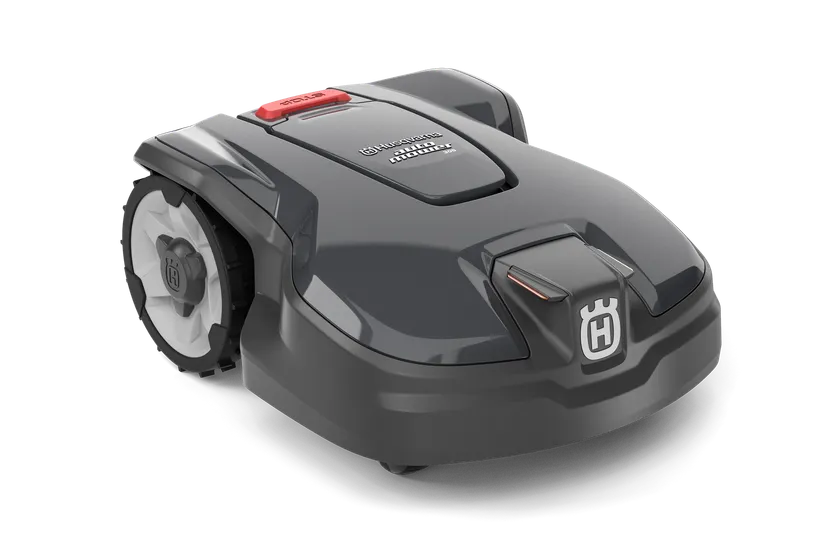
Practical rule of thumb: Don’t buy just by square meters. Narrow passages, slopes, separate zones, short mowing times, and long return trips are often more important than the pure area specification.
The most important decision: Boundary wire, guide wire, or wireless?
In the classic Automower models, the boundary wire is the invisible fence. The guide wire leads the mower back to the station and helps it find remote areas faster. In forums, this exact part is most often criticized: wire breaks caused by animals, spades, scarifiers, garden work, or poorly installed connectors. A mower can be technically completely fine and still get stuck every other day if the installation doesn’t fit.
Typical mistakes include corridors that are too narrow, right-angled cable routing, the guide wire being too close to the boundary wire, unfavorable station corners, and overlapping signals. With the 305, for example, it’s often described that it circles at a specific spot, stops, or repeatedly backs up. In such cases, you shouldn’t suspect the battery first, but rather check the station signal, cable spacing, and return logic.
Wireless competition like Segway Navimow, Mammotion Luba, Dreame or Ecovacs seems more convenient at first glance, because no wire lies in the ground. However, other issues come into play: RTK visibility, GNSS signal blockage, app area limits, reference station, WLAN, LTE, firmware and map maintenance. The classic Husqvarna with a cable is more old-fashioned, but with proper installation it is often predictable. Wireless saves cable work, but replaces it with location and signal planning.
Cable diagnostics in practice
- Check the LED on the charging station: take blinking or color changes seriously.
- Open the connectors and check for moisture, corrosion, or strain.
- Connect the boundary wire directly to the station as a test to narrow down partial sections.
- Check narrow spots in the garden for traces, loops and collisions.
- For recurring breaks, it’s better to replace individual sections than to patch it up every year.
Automower 305, 310 and 315X: compact, proven – but cable-sensitive
The Automower 305 is suitable for small to medium-sized gardens if the area isn’t too fragmented. It can handle narrow passages well, but it needs clean guidance. Many problems with the 305 initially sound like a defect: it gets stuck in relation to the charging station, drives in a zone in loops, or aborts the return trip. In practice, the cause is often in the installation.
The 310 and 315X offer more reserve. This helps when the lawn can’t be mowed every day for long periods or when multiple secondary areas need to be reached. Especially 315X users often praise the mowing result and the comfort once the system is set up. However, if you have many narrow paths and shady, damp corners, you shouldn’t calculate too tightly with these models either.
When it comes to blade wear, the smaller models are pleasantly easy to maintain thanks to their build size. If the cut pattern becomes frayed, the blades turn gray, or fine grass clippings collect on the disc, then dull blades or a dirty mowing disc are likely. If the original disc wears down quickly in everyday use or if you want more cutting reserve, for this model group a robust 6-blade cutting disc for 305 to 415 is an obvious alternative, because it fits precisely within the smaller and mid-range Automower category.
If you’re deciding between 305, 310, 315X, 405X, 410, and 415X, you should also read the detailed comparison: Our in-depth practical comparison of the small Automowers goes deeper into model differences, user problems, and sensible reserves.
Why does my Automower always get stuck in the same place?
If an Automower is always in the same spot, it is almost never by chance. Typical triggers include holes in the ground, soft ground, roots, grass that is too tall at the edge, a incorrectly laid boundary wire, or a corridor that mathematically fits but is too narrow in the actual shape of the garden. In user reports about the 415X after the winter break, it was described that the mower drove slowly and had difficulty moving back and forth in the grass. In the end, a thorough cleaning around the wheels helped as the solution.
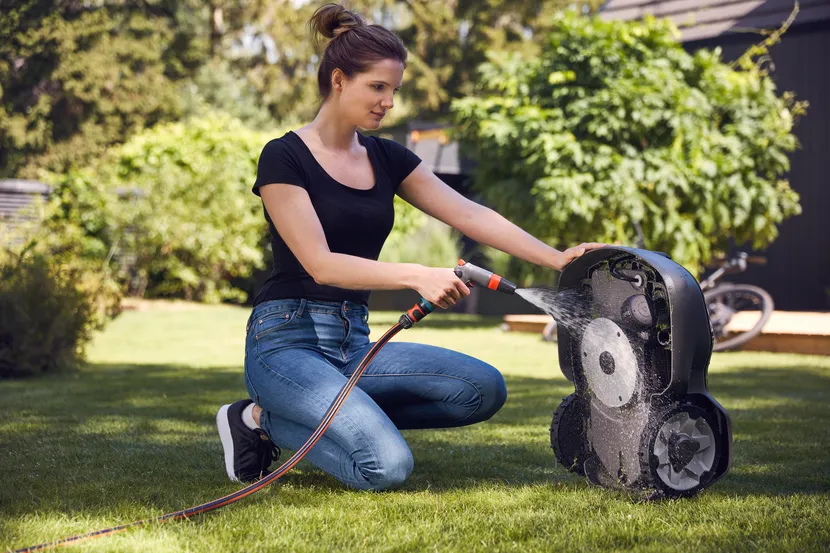
In the workshop, we first check such cases mechanically: Do all wheels rotate freely? Is grass stuck around the axles? Is the blade plate free? Is the underside rubbing? Only then do we look at the sensors and electronics. A dirty mower can cause errors that look like software problems.
- Tall grass: Set the mower to a higher cutting height and lower it gradually.
- Low, damp area: Shift the mowing time, level the ground, or set a restricted zone.
- Narrow passage: Check the wire spacing and route the boundary wire more centrally.
- Dirty wheels: Clean the tread, wheel well, and axle area.
- Station signal: Make the charging station area clearer and observe the approach angle.
- Sensor error: Check the bumper, lift sensors, and moving parts for dirt.
Practical rule of thumb: If the mower always fails at the same spot, mark the location in the garden and film a complete approach. It shows more than ten app screenshots.
Automower 405X, 410 and 415X: Comfort class with app and firmware issues
405X, 410 and 415X are of interest to users who want more comfort: app control, advanced settings, sometimes GPS-based functions, and better adaptation to more complex areas. In practice, however, it becomes clear: the more a model depends on the app, cloud, and firmware, the more error patterns move from the garden into the software.
Many users report commands that are not accepted right away, saved settings that have to be checked again after updates, or cloud connections that suddenly disappear. That doesn’t mean these models are bad. It does mean that buyers should be more tech-savvy than with the simple 305. If you feel every update is a risk and prefer to use only start, stop, and scheduling, a simpler model can sometimes be a more relaxed choice.
First aid for app and cloud frustration
- Stop the mower directly on the device and restart it; don’t just do it in the app.
- Test Bluetooth range/connection before blaming the cloud or mobile network.
- After firmware updates, check schedules, garden coverage, and mowing areas.
- For “no cloud connection,” have the location, mobile signal, and the connect module checked.
- Before a reset, take screenshots of the settings.
When changing the blade, this class is not fundamentally different from the smaller models: clean blades are a must, the disc must rotate freely, and the screws must not be worn out. In our CUT-GUARD tests, we pay particular attention to whether the mower runs smoothly after the conversion and whether grass gets stuck between the blades and the disc.
How often do you need to change the blades on a Husqvarna Automower?
Under normal conditions, Automower blades should be checked about every 4 to 8 weeks and replaced when you can see notches, a gray cutting pattern, or frayed blades. Sandy soil, fallen fruit, pine cones, lots of boundary stones, and wet grass significantly shorten this interval. If you only change by calendar, you often miss that a single damaged blade can throw the disc out of balance.
From our workshop perspective, the cutting disc is just as important as the blade. A worn-out disc, clumped grass residue, or stiff blades create vibrations and worsen the cutting result. With larger Automowers or for users who want more cutting reserve across the entire 305 to 535 range, it’s worth taking a look at a 9-blade cutting disc for Automower 305 to 535, especially when the mower has to handle long run times, high grass load, or many edge areas.
Maintenance that really matters
- Wheels: Clear away buildup from the tread, clean the axle area, and check for free movement.
- Underside: Remove grass mats, but don’t tear at cables or sensors by force.
- Mowing disc: Check each blade individually for smooth movement.
- Charging contacts: Remove oxidation and dirt, and align the charging station level.
- Bumper: Check for free movement, remove grass and small twigs.
- Lift sensors: Take false alarms seriously, but clean first.
Practical rule of thumb: An Automower with sharp blades, clean wheels, and unobstructed sensors often feels like a completely different device. Many “electronic faults” start mechanically.
Automower 435X and 535: Strong on slopes, but not automatically worry-free
435X AWD and 535 AWD are the models for challenging gardens: slopes, uneven surfaces, longer operating times, and larger properties. The all-wheel drive is especially helpful where a 2WD mower would get wheel slip or would have to correct too aggressively on a slope. The articulated design makes the machines more maneuverable than their size would suggest.
Even so, users also report frustration with AWD models. Several docking attempts are mentioned, return issues, firmware behavior, battery or wheel motor problems, and—on newer variants—heat problems in direct sunlight. In particular, dark housings, heated stations, and mowing times around midday can play a role in hot locations. In such cases, a defect is not immediately the most likely explanation; often, shade for the station and mowing times in the morning, evening, or at night help.
The 535 is aimed more at professional or very demanding installations. That doesn’t mean it’s maintenance-free. On the contrary: battery, wheel motors, circuit boards, and connect modules are more expensive components. That’s why dirty contacts or a stiff mowing disc should not be ignored, because follow-up costs in large AWD models can hurt faster.
What does the error message mean?
Error messages are helpful with the Automower, but not always clear. “Trapped” can really mean a hole in the lawn, but it can also be caused by dirty wheels or grass that’s too tall. “Collision” can be an obstacle, but it can also be a blocked bumper. “Lifted” can be triggered by sensors, dirt, or a jammed housing mechanism.
| Error message | Likely cause | First action |
|---|---|---|
| Stuck / trapped | Hole, soft ground, tall grass, dirty wheels | Check the area, clean the wheels, increase the cutting height |
| Collision front / rear | Blocked bumper, grass clippings, sensor problem | Move the housing, clean it, make sure there is free spring travel |
| Lifted | Lift sensor dirty, magnet/sensor problem | Clean the underside and sensor areas; if the error persists, contact service |
| Charging station blocked | Uneven station, obstacle, contact problem, approach angle | Level the station, clean the contacts, create a clear approach |
| No cloud connection | Mobile network, connect module, app, firmware | Test locally via Bluetooth, check the app, have the dealer diagnose if the error persists |
| Settings not saved | App/firmware problem, synchronization | Restart, save again, after an update check all profiles |
Control boards, wheel motors, battery packs, and communication modules are not typical “quick DIY” repairs. Cleaning, blade replacement, contacts, and visual inspection are DIY-friendly. As soon as water gets into the housing, contacts are burnt, recurring sensor errors or motor errors occur, the specialist dealer is the better place to go.
Buying advice from a user’s perspective: When an older, simpler model can be the better choice
Bigger and newer isn’t automatically better. Many users praise older corded Automower models because, after a clean installation, they simply do their job for years. If you have a straightforward garden, don’t need complex app zones, and have a reliable dealer nearby, you’ll often be happier with a 305, 310, or 315X than with a feature-rich model whose cloud and firmware behavior gets on your nerves.
A newer X or AWD model is worth it if the garden is truly complex: slopes, multiple zones, long paths, larger areas, and a high demand for control and mowing schedules. But then maintenance readiness should also be a good fit. A 435X or 535 doesn’t just need space in the garden—it also needs a clean station, clear maneuvering area, regular cleaning, and realistic mowing times in hot weather.
Against wireless competition, Husqvarna remains more conservative with its classic wired models, but also more predictable. RTK and LiDAR mowers from other brands can be strong in open areas, but depending on the garden they may struggle with signal loss, map maintenance, app limits, or the reference station. If you’re willing to use wire and lay it neatly, Husqvarna provides a proven foundation. If you don’t want wire, you should check before buying whether trees, house walls, narrow passages, and mobile reception truly allow reliable wireless operation.
Frequently asked questions
Which Husqvarna Automower is suitable for 600 m²?
For a real 600 m² with a simple layout, the Automower 305 fits well; for narrow passages, separate zones, or short mowing windows, more reserve is sensible. In that case, you should rather consider the 310, 315X, or 415X instead of running the 305 permanently at its limit.
How do I find a cable break in the Automower?
The fastest way is to narrow down the cable break using the charging station LED, sections of the loop, and test bridges. First check connectors, freshly worked areas of the garden, edges, and places where animals or tools may have damaged the cable.
What should I do if my Automower ignores app commands?
First restart the mower and the app, and test the connection via Bluetooth when you’re close to the devices. If local control works but cloud commands don’t, mobile reception, the Connect module, the server connection, or firmware are more likely causes.
Why does my Automower report a collision or lifting without an obstacle?
Most often, dirt, jammed moving parts, or sensor issues are the first suspects. Clean the underside, bumpers, wheel areas, and lift sensor components thoroughly before suspecting the circuit board or cable harness.
Are 435X and 535 AWD always the best choice on slopes?
For steep inclines, the 435X and 535 AWD are often the right class, but they are not automatically worry-free. Docking, heat, the app, the battery, wheel motors, and cleaning remain important topics—only the traction is clearly better than with 2WD models.
Conclusion: The best Automower is the one that fits your real garden
Husqvarna Automower models from 305 to 535 can work very reliably when model selection, installation, and maintenance fit together. However, the most common user problems clearly show that cables, guide wires, the charging station, the app, and dirt are often more important than a single data sheet feature. A 305 can run excellently in the right garden, while a 435X AWD may unnecessarily struggle in an unfavorable corner of the station.
Therefore, before purchasing, don’t just check the square meters, but also bottlenecks, slopes, reversing paths, shade, heat, app requirements, and access for service. And after the purchase, the rule is: regularly check the wheels, sensor areas, charging contacts, Messerteller and Klinge(s). That’s exactly where everyday performance is decided—whether your Automower mows quietly and unobtrusively, or whether you’re back next to the charging station wondering why it’s getting stuck again.
Comments