The robot drives out of the corner next to the flower bed, turns at the end of the zone, and heads back toward the charging station—right there, a slightly frayed strip remains. On thin grass, the turn can even leave a small, roughened spot behind. Such images are not only caused by dull Klingen: With cordless mowing robots, the causes often first lie in the map, the boundary layout, the turning maneuver, or the path back to the station.
The HOOKII Neomow X SE is a young LiDAR/vision system, the result of which depends heavily on the garden map, installation location, ground conditions, reception situation, and software version. It is not a guarantee that track offset, edge problems, or difficulties when returning to the charging station are fundamentally ruled out.
For 2026, there’s also this: Long-term experience with the specific Neomow X SE is still limited and therefore not yet reliable. This is not an automatic defect—but a reason to check your own garden geometry more honestly before buying than the mere area information on the data sheet.
The HOOKII Neomow X SE in one sentence: Who is the concept intended for?
The Neomow X SE is aimed at owners of larger or more intricate lawn areas who don’t want to lay boundary wire or position an RTK antenna, but are willing to map the area cleanly via the app and carefully monitor the first mowing runs.
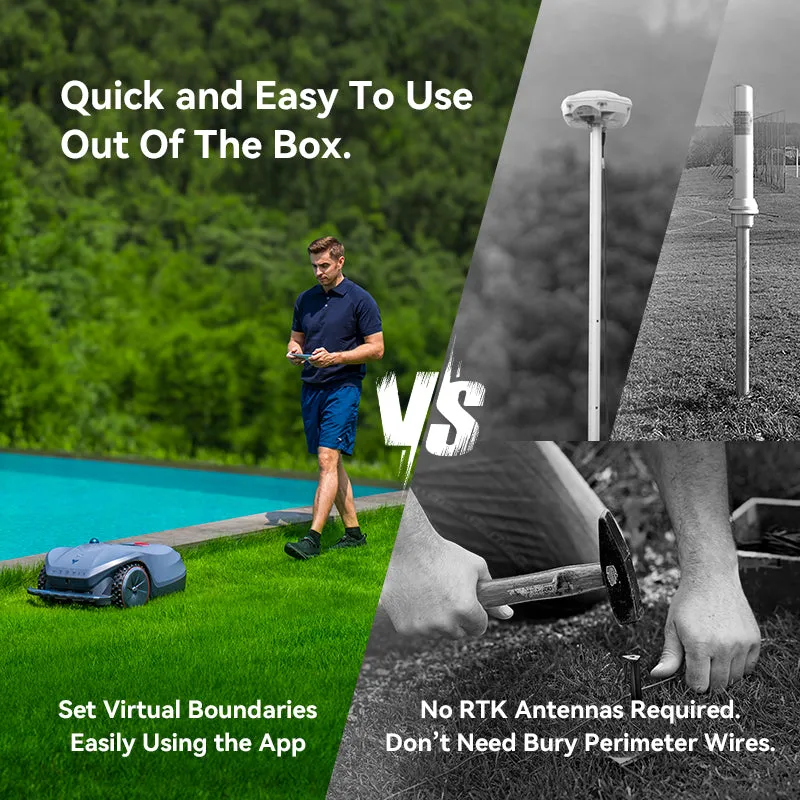
At first glance, this sounds like a simple purchasing decision: no cable, no antenna, the robot drives. In real workshop practice, however, the key question is narrower: Does the garden fit the map-based navigation? An open lawn with only a few fixed obstacles is something completely different from three separate areas, an island behind the house, and a narrow passage between a wall, a tree, and the edge of a flower bed.
That’s why our practical fit criterion is this: it’s not just square meters that matter, but also the number of zones, the quality of the connection between them, and the length of the return trips. Unconnected lawn islands are critical. Just as important are trees in the passage, confusing sections, and the question of whether there is enough space in front of and behind a narrow corridor for entering and exiting.
Does the HOOKII Neomow X SE really not need a boundary wire or an RTK station?
No: For the HOOKII Neomow X SE, neither a boundary wire nor an RTK reference station is provided. Its navigation is based on 3D LiDAR SLAM and camera/vision functions; the lawn area, zones, and restricted areas are set up in the app.
Many misunderstandings arise right here. “Wireless” does not automatically mean GPS or RTK navigation. With the RTK system, the robot receives its precise position reference via satellite data and a reference station. The HOOKII, on the other hand, uses LiDAR—an optical distance sensing method—to scan its surroundings and navigate using a self-created map.
| Area | LiDAR/vision system like Neomow X SE | RTK system |
|---|---|---|
| Boundary | Virtual boundaries on the map | Virtual boundaries based on precise position data |
| Hardware in the garden | Charging station, no RTK antenna, no wire | Charging station plus RTK reference or correction service |
| Under trees | LiDAR can be an advantage here | Satellite visibility and correction signal must remain stable |
| Important test point | Map, fixed environment, edges and driveways | Reference location, sky visibility, and position stability |
Vision and RTK should not be lumped together. Vision helps primarily with orientation nearby and with the detection and avoidance of objects—the Vision object avoidance works mainly during the day. LiDAR, map, WLAN, and 4G/LTE, on the other hand, depending on the function, relate to zone planning, map management, the logic of the return trip, and safe control via the app.
Even without an antenna, the charging station remains mandatory. It is the charging point and the return destination. Anyone reading “without a base station” should therefore distinguish precisely: it means without an RTK base, not without a charging spot.
Practical rule of thumb: No boundary wire and no RTK station save installation work—but they do not replace mapping, a sensible station location, and clean virtual boundaries.
How does setup with the charging station, app, WLAN, Bluetooth, and 4G work?
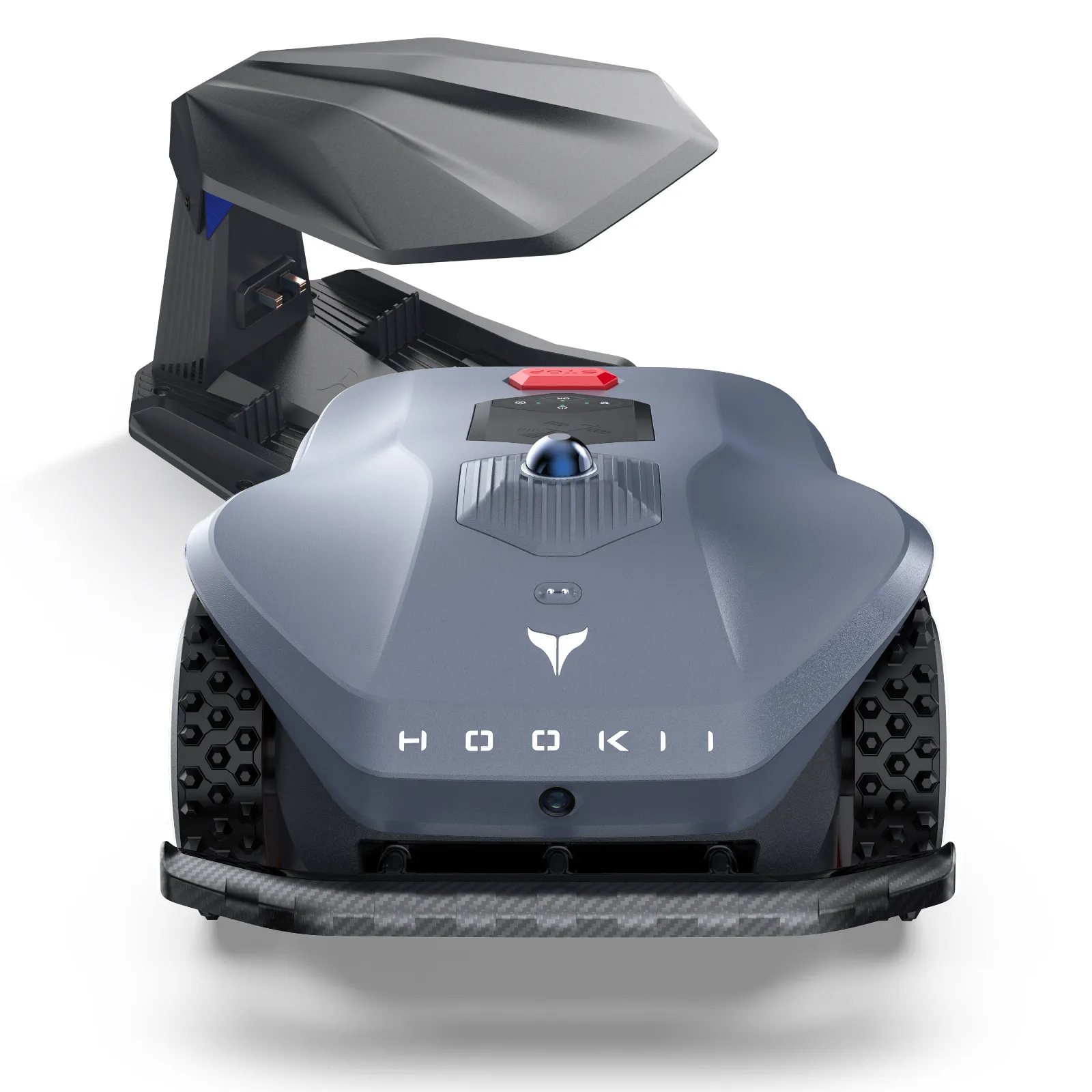
The initial installation determines whether the Neomow drives calmly across the area or repeatedly starts shifted at a zone. Before the first mowing, the charging station should be placed on a level, solid surface, with a clear approach and exit area. A station directly at a tight corner of a wall, under deep branches, or immediately in front of a narrow passage is an unnecessary source of errors.
With the older, cable-connected Neomow S, forums have occasionally reported WLAN, Bluetooth, and app issues: connection errors with routers, cumbersome login processes, and a not very transparent map interface. This is not proof of a fault in the X SE. However, it shows which points buyers should not skip with the current model.
Checklist before the first complete mowing plan
- Install the current HOOKII app and grant Bluetooth, location, and network permissions to the smartphone.
- Check the firmware of the robot and the app before final mapping.
- Test the 2.4 GHz WLAN at the house and especially in the area around the charging station.
- If using LTE/4G, check whether the connection is stable in the more distant zones.
- Create a small test zone first, then add restricted zones, connection routes, and additional areas.
- After saving, open the map again and check whether zones, no-go areas, and the return route are truly retained.
What matters is the separation between the garden and the map: the garden has real edges, height differences, gravel, walls, and flower beds. The map is only the driving logic that the robot is supposed to reflect this reality. A nicely drawn theoretical line doesn’t help if it runs along a slanted lawn edge that is actually driven over when turning.
Virtual boundaries and no-go zones therefore need to be planned up to the visible, real edge—not up to an imagined line from the property plan. Also factor in the movement when turning: in a turning maneuver, a mowing robot doesn’t drive the same way as it would on a straight path. Its rear, wheels, and turning radius can come closer to a flower bed, curb, or bark mulch than expected.
Does the Neomow X SE work under trees and in complex, narrow gardens?
Under tree canopies, a LiDAR-based approach can generally be appealing because it isn’t primarily dependent on a clear satellite view for RTK positioning. However, that doesn’t automatically make the Neomow X SE an effortless specialist for every shaded area. Deep branches, constantly changing garden furniture, piles of leaves, reflective windows, and very narrow sight lines change the environment that the map refers to.
In complex, narrow gardens, short bottlenecks and long reverse movements are often more important than the total area. The manufacturer’s specification of a minimum width of 77 cm can be a starting point. In practice, however, a passage should be wider and calmer than the bare number suggests: a flower bed on the left, a wall on the right, and a tree trunk in the driveway area create a significantly more difficult situation for the robot than two straight, open edges.
Convert the area figure into real zones, maps, and transfer routes. A 3,000 m² property with a contiguous lawn area is something different from 1,200 m² of main area, 500 m² behind the house, two narrow side strips, and an island without direct connection. For separate areas, the robot may need to be moved; the maximum label area helps there only very little.
The Vision function should not be understood as a free pass for scattered toys, loose branches, or pets. Plan mowing windows as much as possible during bright hours. Do not rely on object avoidance at dusk and at night, even if LiDAR can support spatial orientation. Children, animals, the garden hose, a ball, and freshly fallen branches remain a checkpoint before every start.
Practical rule of thumb: LiDAR can mitigate overhanging branches, but narrow passages, real edges, and changing obstacles are not solved by a large area specification.
Is 3,000 m² realistic for the HOOKII Neomow X SE?
3,000 m² are conceivable as the manufacturer’s maximum area, but not automatically the realistic daily output in a complex garden. What matters is not only the battery and cutting width, but also charging cycles, zone changes, slopes, turning maneuvers, grass growth, and the time the robot loses for long return trips to the station.
For the X SE, around 700 m² per charge and approximately 180 minutes of mowing and charging time are stated. The result: on an open, easily accessible area, the robot can distribute the work over multiple trips. With many islands, passages, or return routes, the usable portion of mowing time decreases. If you don’t keep dense growth permanently short, the cutting system is forced to do more work as well.
Instead of “My property is 3,000 m²,” the calculation should look like this: How many square meters are actually lawn? How many of those are located in a contiguous zone? How many meters does the robot travel to the next area or back to the station? And during the selected mowing times, is there enough light for vision object detection?
When it comes to cutting quality, it’s worth not pitting the map against the mechanics. If the robot navigates cleanly to the same turning points, but blades fray or grass gets stuck under the mowing disc, the underside becomes relevant. If you want to permanently improve the mowing pattern and the drainage under the device, you’ll find with us suitable cutting discs for lawnmowers that can play a sensible role during maintenance or when converting the blade area.
Edges, obstacles, and slopes: Where should you not expect miracles?
Even a well-mapped LiDAR robot doesn’t physically cut through a high lawn edge, a curb, or the edge of a vertical wall. There is a structural gap between the housing, cutting disc, and the obstacle. At hard edges, rework is therefore normal—especially then when the virtual boundary should not be placed directly up to the edge for safety reasons.
On slopes, it’s not just the percentage value that matters, but also the ground surface. A smooth ramp with dry, dense grass is easier than a short, uneven incline with roots, loose soil, and a turn at the end. Especially when turning, a front-wheel drive can react differently than during straight driving: the wheel slips slightly, the robot starts off at an angle, or the mowing disc rubs longer over thin patches of grass.
When the robot drives over the edge and leaves a frayed strip behind
The order of troubleshooting is crucial. Many owners immediately reach for new blades. That can be correct—but only after the four previous checks.
- Check the app map and virtual boundaries: Is the boundary really at the visible edge of the lawn? Is there a kink, a too-narrow restricted zone, or a transition that the robot interprets differently when turning?
- Check the position of the charging station and its relationship to the WLAN: Does the robot have to pass through a narrow area right after starting or on the way back? Is the station placed so that the approach can be straight and unobstructed?
- Check the stability of the position and the connection: Watch for jumps at the edge, at transitions, or in passages. With other systems, satellites, RTK, or nRTK would need to be checked; with Neomow, map stability and the WLAN/LTE connection in the respective zone also matter here.
- Only then check the cutting area: Check the blades for free rotation and sharpness, clean the cutting disc of grass residues, evaluate the cutting height, and look for a damaged or clogged mowing area.
A particularly meaningful repeat test takes only a few minutes: as a trial, remove three to five loose items or small branches from exactly this area. If the robot then drives over the same strip again in the same spot, this is more likely to indicate the map, boundary, turning logic, or floor geometry. If the pattern disappears, it was probably a local obstacle that triggered it.
In our tests on blade plates, we also found: damp clippings and fine grass residue tend to collect preferentially where there is little clearance between the mowing disc, the blades, and the underside. Therefore, clean after mowing in wet conditions before you suspect a navigation problem.
Known weak points and open questions about the Neomow X SE
With the specific Neomow X SE, the most important open question is not a clearly documented recurring series defect, but the limited independent long-term experience. The early assessment looks positive, but the few reviews and short ownership periods do not prove lasting map stability or the availability of replacement parts after several seasons.
In forums, the older Neomow S is occasionally reported to have difficulties with WLAN, Bluetooth, setup, and map transparency. These indications must not be presented as a defect of the X SE, because it is a different, older model concept. For potential buyers, however, they are still useful: app operation, saving maps, firmware updates, and the specific support path should be tested consistently within the return period.
Before purchasing, these questions should therefore be added to your own checklist: Is there support in German? How quickly are replacement blades, screws, blade plates, and the battery available? What is the returns process like? After an update, can zones be quickly checked and corrected? And can the robot pass the critical section in the garden ten times in a row without any misalignment?
Frequently Asked Questions
Does the HOOKII Neomow X SE need an RTK station?
No, the Neomow X SE does not require an RTK reference station. It uses LiDAR-SLAM and Vision for navigation and works with a virtual map. The charging station is still required, however, so the robot can charge and plan its return trips.
Do boundary wires need to be laid for the Neomow X SE?
No, boundary wire is not necessary. Instead, the work area, zones, and restricted areas are created via the app. However, the virtual boundary must be planned sensibly along the real lawn edge—especially in front of flower beds, walls, and narrow passages.
Does the Neomow X SE work at night under trees?
For safe object detection, you should schedule mowing times for bright daylight hours. LiDAR can be helpful for navigation when there is overhanging tree cover, but the Vision obstacle avoidance works primarily during the day. At dusk and at night, loose obstacles, animals, and toys should not be left to the technology.
Are 77 cm passage widths sufficient in every garden?
77 cm are only a technical guideline, not a guarantee for every passage. A straight, clear passage is easier than the same width with a garden bed edge, tree trunk, slope, or a tight turning area. Plan in some extra margin and test the passage multiple times in both directions.
Why does an unmown or frayed strip remain along an edge?
First check the map, the virtual boundary, the path to the station, and the repeatability of the driving pattern. Only once the robot drives there stably and correctly are the next candidates the blades, cutting disc, cutting height, and grass clippings under the mowing deck.
Conclusion: Buy now or wait with the HOOKII Neomow X SE?
The HOOKII Neomow X SE is of interest to buyers who are looking for a cable- and RTK-free concept and have a garden with clearly understandable zones, fixed edges, and enough space in critical passages. Especially with overhanging branches, LiDAR can be a sensible alternative to systems that rely purely on RTK.
Those who should wait or, in particular, test very thoroughly are buyers with many areas separated from each other, narrow passages, changing obstacles, and very high expectations for perfectly cut edges. The technology is still new, and the independent long-term data for the X SE is limited—and the quality depends not only on the robot, but also on the map, the station, the connection, the ground, and a clean blade area.
If you decide on the system, you shouldn’t just look at the total area in the first few weeks. Above all, observe the return trip, turning points, edges, and the underside of the mowing unit. That’s exactly where you’ll see whether the Neomow X SE in your own garden only looks impressive—or works cleanly and reliably over time.
Comments