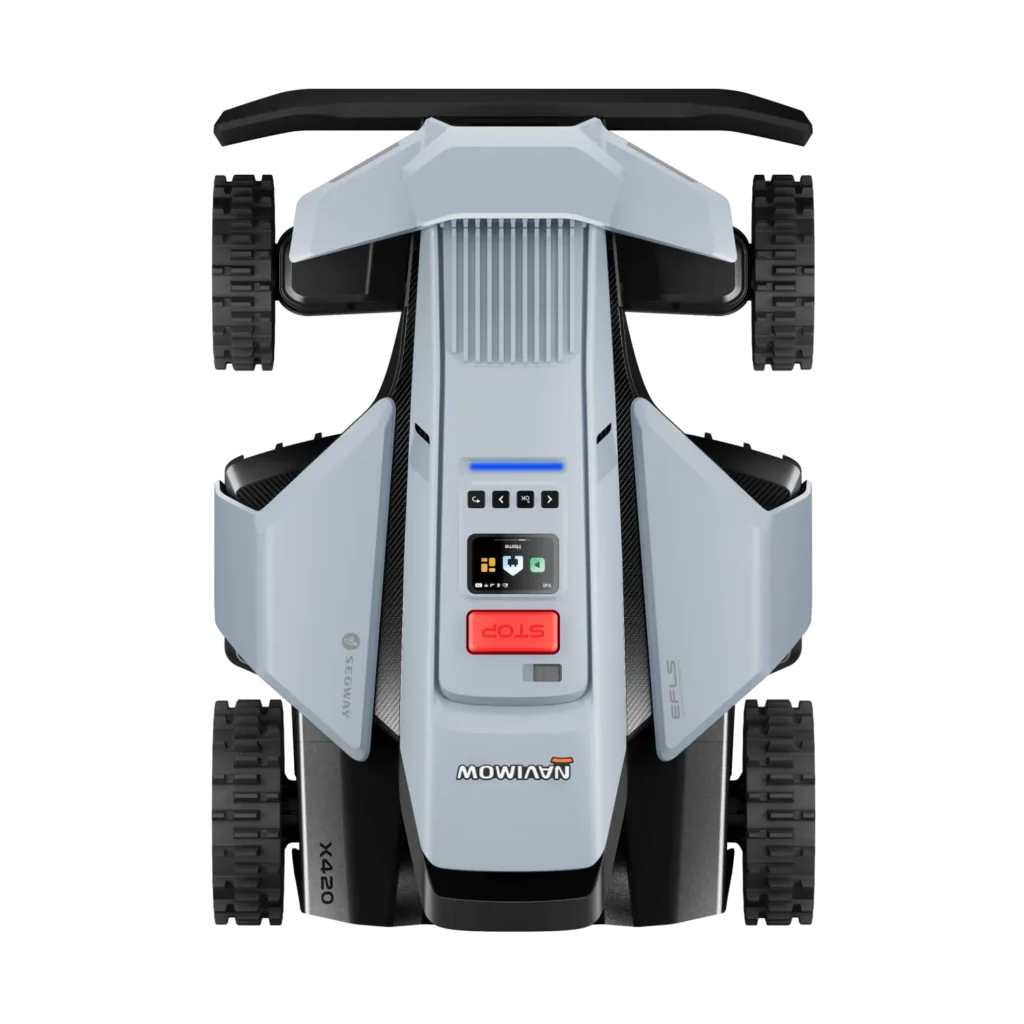
On the paved path, the robot is still running cleanly; just before the edge of the flower bed it turns off—and what’s left behind is a frayed strip or a slightly torn-up spot in the thin lawn. Such problems usually don’t show up with the Navimow X420 on the straight, open area, but rather at edges, during turning maneuvers, in narrow passages, and when reversing back to the station.
The Navimow X420 is a young system, and its results depend heavily on the map, the installation location, the ground, the reception conditions, and the software version. Anyone buying it should not expect a guarantee that track misalignment, edge problems, or difficulties when reversing in their own garden are completely ruled out; long-term experiences with this model are still limited.
Navimow X420 in practice: Which gardens are suitable for the all-wheel mowing robot?
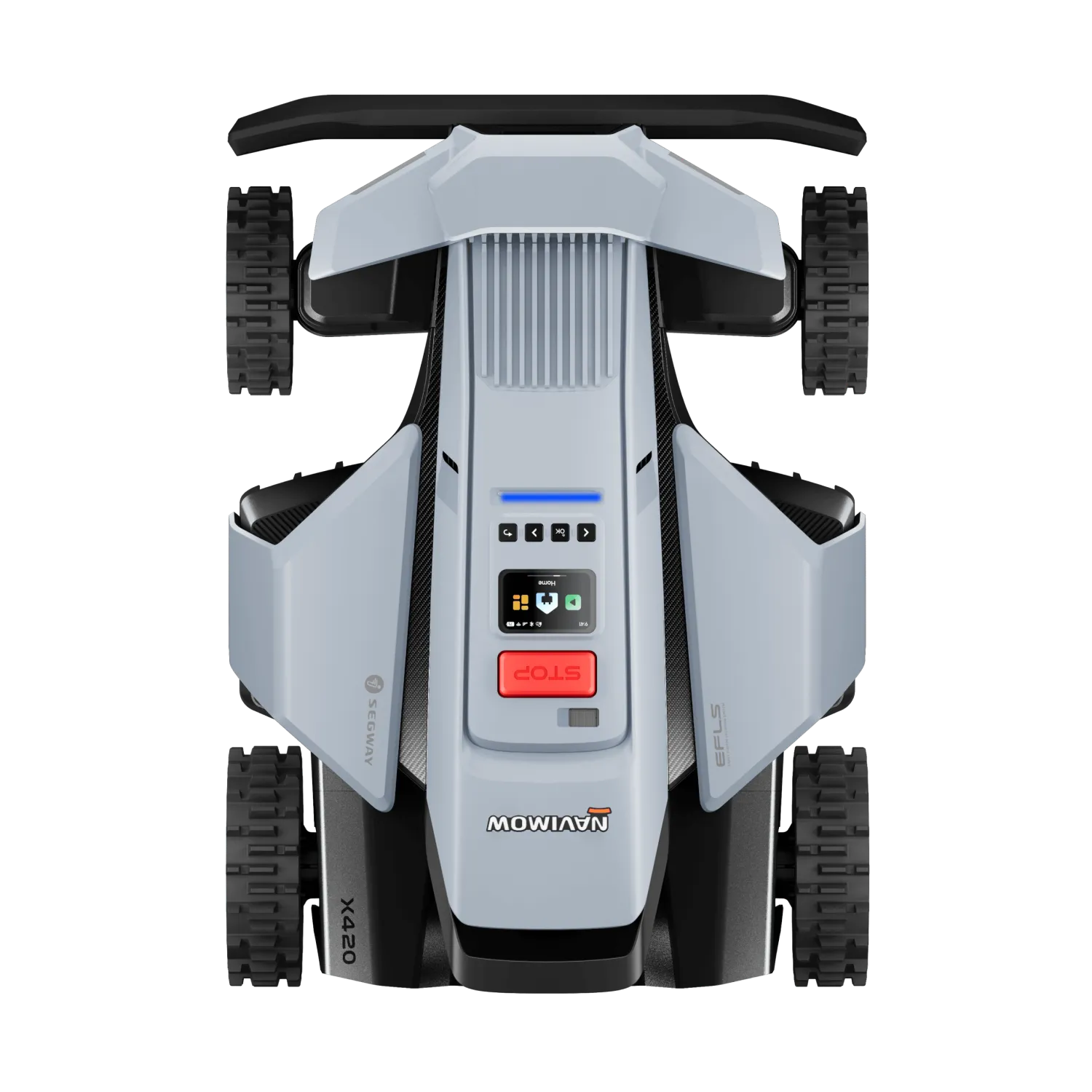
The X420 is not a typical robot for a small, rectangular townhouse lawn. Its strength is where slopes, uneven sections, intricate contours, or longer driving routes come into play. In forums, owners report positive results on slopes, with many trees, and on complex properties—though often only after the map, station, and positioning system have been set up properly.
In our tests of cutting discs and blades, we regularly see: A powerful drive does not solve planning errors. Especially on terrain with bumps, soft spots, or transitions between lawn and paving, the robot must not only have traction, but also keep its position stable and have enough space to turn.
The area on the label is not the whole truth
The nominal area class is only a starting point. An open lawn with 1,200 m² is much easier for a robotic mower to handle than 1,200 m² with three zones, two narrow passages, many trees, a long return trip, and several smaller sections. Particularly short mowing windows, long routes to the charging station, and frequent zone changes shift the buying decision from “number of square meters” to “map, zones, and transfer routes.”
| Garden situation | Assessment for the X420 |
|---|---|
| Large, contiguous area with moderate slope | Good starting conditions if the map and reception are stable. |
| Many trees, the house side, or a shaded passage | Check the positioning system in advance and the possible antenna location. |
| Separated lawn islands without a sensible connection | Critical: Manual relocation is not a reliably planned routine. |
| Narrow passages and tight turning points | Only suitable if not just the passage, but also the approach and exit remain clear. |
The right robot size is not determined by the highest number in the datasheet, but by zones, return routes, slope, and the actual available mowing time.
Does the Navimow X420 really not need an RTK antenna?
No, an RTK antenna is not absolutely necessary in every garden—but it can be useful with trees, house walls, side passages, or difficult secondary areas. Users do report good results without an antenna when network coverage is adequate, but others describe position fluctuations in shaded or laterally located areas.
It’s worth keeping these systems clearly separated: nRTK, RTK, WLAN, and LTE mainly relate to planning, position stability, safety logic while driving, zone management, and returning to the station. The vision system, on the other hand, works in the near field: it orients itself using visible structures and helps with obstacle avoidance, but it does not replace a reliably planned map and a secure position reference.
When the antenna provides more safety
An additional antenna solution is especially worth considering when the area behind the house is involved, runs under dense tree cover, or is reached through a narrow corridor. Even if the robot repeatedly drives slightly offset in the same spot, hesitates near a boundary, or seems unsettled during transitions between zones, you should first check position stability—not immediately the blade or the drive.
- Check the reception situation at the station, at the problematic edge, and at any possible bottleneck separately.
- Don’t plan the station only based on the power outlet, but also on WLAN proximity, a clear exit, and stable return-driving logic.
WLAN is not a substitute for another positioning system. It can support the connection to the app and parts of system communication, while RTK or nRTK remains relevant for precise navigation and map logic.
Vision doesn’t work like a free pass
Vision object avoidance works primarily during the day. That’s why you should schedule the most important mowing windows for bright hours and don’t rely on the fact that a night run in every garden will deliver the same obstacle detection. Some users also describe cautious behavior when the growth is high or when the cameras are dirty: Tall dandelions, damp sensor surfaces, or adhering dirt can unnecessarily slow the robot down or cause it to swerve.
Above all at the start of the season, the lawn should not be overgrown. Check the camera covers, remove any coarse blades before the first run, and observe whether the X420 repeatedly avoids the same spot—this provides better clues than a blanket judgment about the Vision technology.
The most important real user problems: Updates, maps, boundaries, and secondary areas
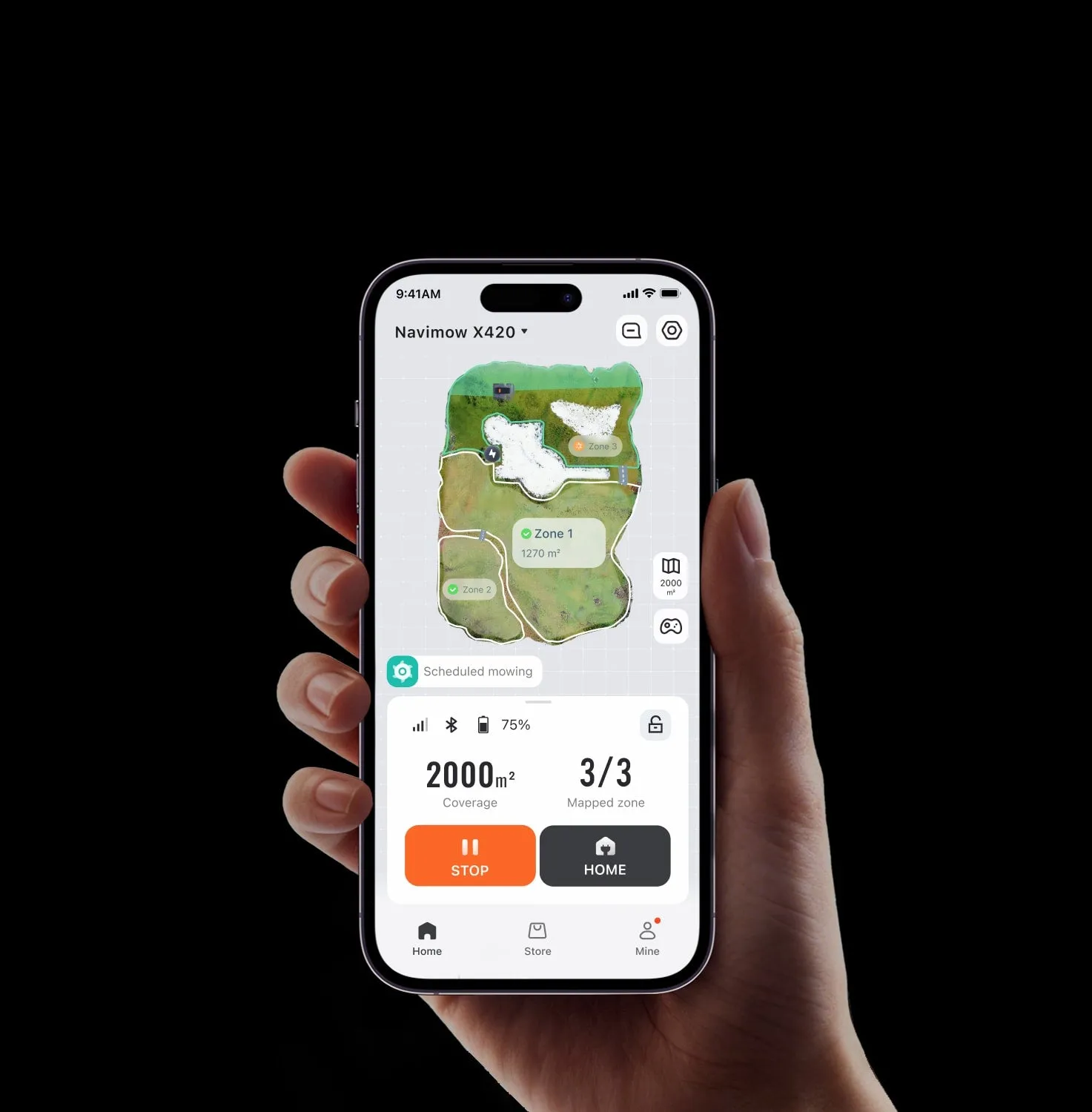
Many users report difficulties right after commissioning: a crooked straight-ahead track, apparent obstacles without any visible reason or warnings around the front drive. Several early owners describe that a firmware update offered to them only worked properly after a complete restart. This leads to a clear workshop rule: don’t start a weekly schedule immediately after unpacking—first handle the software version, a restart, and a test drive.
Checklist before the first fully automatic mowing schedule
- Check the firmware in the app, complete the update, and then fully restart the robot.
- Carry out a short test drive on open ground: observe straight-ahead tracking, turning, boundary travel, and the return to the station.
Even with remote access, the same applies: 4G and the app are practical features, but not an infallible long-term solution. Some owners report problems with loading or editing the map after app updates over the mobile connection. If you frequently need to intervene from afar, you shouldn’t plan map changes only when the robot is already at the other end of the property.
Virtual boundaries: safety distance instead of millimeter trust
In forums, it’s criticized that virtual boundaries or no-go zones aren’t consistently respected in every situation. Therefore, no map should be stitched right up to the edge at pond edges, wall projections, steps, and sensitive paving borders. Set boundaries and no-go zones only up to a clearly visible edge—not up to an imagined line in the grass.
Also take into account the actual turning clearance: the housing pivots out, wheels can shift on a slope, and the robot needs more buffer before an edge than it does on a flat indoor surface. Garden geometry and map data are two different things. A neatly drawn boundary does not automatically make an unfavorable flowerbed shape, a soft edge, or a sloping paving-stone edge safe.
Virtual boundaries are a navigation tool, not a substitute for a safety margin. The more critical the edge, the more generous the real buffer must be.
Can the X420 mow separate lawn areas?
Only to a limited extent: a separate area should ideally be reachable in a sensible way and integrated into the navigation; simply carrying it there is not a reliable long-term solution. A specific user report describes that after manually moving it, the position estimate is significantly wrong, mowing is imprecise along a paving-stone edge, and the blades continue to drag.
The problem is understandable: the robot doesn’t just need to be standing somewhere on grass, but must also reliably determine its position relative to the map. A remote island behind a wall, a narrow strip next to the house, or an area that can only be reached by manual repositioning can overwhelm the map logic—even if the pure square-meter count is small.
Assess narrow passages correctly
Don’t just measure the narrowest point between two obstacles. What matters is the entire movement: approach, steering angle, possible incline, exit, and the question of whether the robot can safely find the same passage again on the way back. A passage that looks generous when stationary can be too tight when turning or with slight track deviation.
For permanently separated areas, a second, sensibly planned mowing strategy is often better than a robot that has to be moved by hand again and again. If you do move it anyway, you should observe every trip at the beginning and pay particular attention to edges, steps, and the cutting zone.
Slope, uneven ground, and wet lawn: How practical is the all-wheel drive?
The all-wheel drive helps the X420 on slopes and uneven terrain, but it doesn’t eliminate the physical limits of the lawn. Positive reports come from owners with steep sections, a stream bed, narrow paths, and many trees; there are also good experiences on slopes with the antenna. Still, wet ground remains a risk factor for wheel slip, deep tire tracks, and sideways shifting.
In practice, it’s not just the steepest spot that matters, but the combination of incline, soil moisture, the turning point, and the surface. A short ramp can work, while a nearby flatter area can be problematic due to soft ground. Check especially the areas where the robot turns uphill or travels across the slope along a boundary.
- When the ground is visibly soft, shift mowing times instead of having the robot turn multiple times on the same track.
- After the first runs, check the tire pattern, turning points, and the actual driving path—not just the visual mowing result.
All-wheel drive provides reserves while driving. For a clean result, however, the X420 still needs a firm surface, sufficient turning area, and a map with distance from critical edges.
Mowing pattern, lawn edges, and follow-up work: What to do when strips are missed?
Missed strips do not automatically result from dull Klingen. Users report visible tracks, especially where wheels press down blades; in addition, there currently apparently isn’t an easy Spot-Mow function for exactly one overlooked spot. Therefore, first check whether the strip always appears at the same point on the map or only shows up after a specific direction of travel.
If the X420 drives away from an edge and leaves a frayed line behind, work through this sequence: First, check the app map and the virtual boundaries. Second, check the position and the station’s location in relation to the WLAN and the available exit. Third, assess the stability of the position—especially the satellite, WLAN, or LTE situation, as well as possible jumps at edges and transitions. Only then should you check the Messer, Mähteller, cutting height, and grass clippings under the housing.
The repeat test on branch, leaf, or “Pasek”
If, at the exit point, a small strip regularly appears or the robot noticeably swerves there, test by removing three to five random small objects or twigs. Then compare the driving path and the exact location of the strip. If the pattern is reproducible, you should check the map and the WLAN range in this area before blaming the vision recognition as the main cause.
For the cutting side, the rule is: blades must be able to swing freely, be mounted evenly, and have no bent screws. If you mow frequently along curb stones, you should check more quickly after each contact. The inspection points include a swiveling blade, an undamaged blade seat, and no scoring marks or clumps of grass on the cutting disc.
If a lot of clippings collect under the standard mowing disc or the blades need to be checked more quickly after contact, it’s worth taking a look at robustly built cutting discs for Segway for maintenance. With CUT GUARD, during inspection we pay special attention to ensuring that blades remain movable and that cutting residues do not unnecessarily get stuck between the mowing disc and the blade area.
Buying advice: Is the X420 enough for your area?
For a large, contiguous, and well-mappable lawn area, the X420 may be a good fit. However, for an area close to the maximum model class, you should plan some reserve—especially on slopes, with multiple zones, long reverse travel distances, many obstacles, and limited time windows. In German forum discussions, for complex properties it is explicitly recommended not to size too tightly.
Therefore, the purchase is a better fit for owners who are willing to set up the map and layout carefully and actively monitor the first few weeks. Anyone who has a fully separate secondary area, extremely narrow passages, or a critical drop-off edge without structural protection should not only look at the advertising promises of wireless navigation, but should first honestly assess the actual geometry of their garden.
Frequently Asked Questions
Does the Navimow X420 need an RTK antenna near trees?
With dense tree coverage, house-side areas, or recurring positioning problems, an antenna is recommended. Without an antenna, the X420 can work well in open gardens, but shading, narrow side passages, and separate areas increase the risk of unstable position data.
Can I simply carry the X420 to a secondary area?
For permanently separated lawn areas, manual relocation is not a reliable solution. The robot must be able to assign the area stably to the map; user reports show that after moving it, there can be a noticeable shift in position.
How much edge space remains with the Navimow X420?
Depending on the edging, you should realistically plan for about 10 to 15 cm of remaining edge. Before purchasing, especially check curb stones, raised beds, and walls, because the robot drives there with a safety distance and cannot cut into every corner.
What must happen before the first mowing session?
Check the firmware, restart the X420 after the update, and run an observed test drive. Test straight-line travel, turning maneuvers, boundary travel, and the return to the charging station before an automatic weekly schedule runs.
Is there an easy function for a single missed strip?
Users currently miss a straightforward spot-mow function for exactly one overlooked spot. Practically, this means you should check the cause of the strip and, if necessary, plan an additional mowing pass for the relevant zone.
Conclusion: The X420 is strong when the map and the garden match
The Segway Navimow X420 can be a convincing solution for large, steep, and intricate areas. Its limits are less about pure drive power and more about the map, positional stability, separate areas, critical edges, and whether the garden provides the robot with enough room to move.
Anyone who plans the station, reception, transitions, and zones before purchasing starts out significantly better than someone who only looks at the square-meter figure. And anyone who works systematically on the mowing pattern—first map and position, then Klingen and cutting disc—will usually find the cause of strips and frayed edges faster than with a blind parts replacement.
Comments