The Automower spots a small branch, brakes, turns away—and leaves an unmown strip exactly there. Two trips later, it still doesn’t get stuck on a flat hose. And along the rocky edge of the lawn, it drives so carefully that the border either remains open or the robot, when turning, ends up back in the problematic area. Exactly between these situations, the new Husqvarna Automower NERA with AI Vision decides whether the technology will be a relief in your own garden or whether it requires additional control.
The 2026 NERA generation with a camera is a young system. Its behavior depends heavily on the map, installation location, ground conditions, reception situation, and software version. Individual positive or negative experiences are therefore no guarantee for how it will behave in the next garden—and they explicitly have no exclusive effect. Long-term experiences with the new Vision models are still limited in summer 2026 and are not yet sufficient for reliable statements about continuous operation or the blade replacement interval.
Husqvarna NERA with AI Vision 2026: Which models are new—and for whom?
For the EU market, the Automower 405VE NERA, 410VE NERA, 430V NERA, and 450V NERA belong to the new model group with integrated AI Vision. The camera is intended to recognize objects in front of the robot, classify them, and treat them differently depending on the risk. In addition, it works with infrared support so that object detection remains fundamentally usable even in the dark.
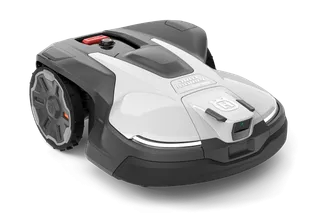
Choosing the right model should not start with the area size. A value like 600 m² or 900 m² describes a contiguous, sensibly connected working area—not the size of an arbitrarily intricate property. In practice, two separate lawn islands, a narrow passage behind the house, and a long return route to the charging station can matter more than an additional 200 m² listed on the data sheet.
| Checklist item | Decisive in practice |
|---|---|
| Working area | Consider a contiguous area instead of adding up individual pieces. |
| Zones | Multiple zones only work comfortably if transitions and reverse movements remain logical. |
| Islands without connection | They are critical: The robot cannot switch between them on its own. |
| Reception and connectivity | Satellite correction, mobile data, or Wi-Fi must fit the mapping and return logic. |
| Edges | Rocks, garden beds, edging, walls, and terraces require realistic mapping. |
Vision and RTK or EPOS fulfill different tasks. The camera helps above all with near-range detection and avoiding visible objects; in practice, this can be assessed reliably mainly under good lighting conditions. Satellite positioning, maps, and WLAN or LTE, on the other hand, provide the basis for zone planning, virtual boundaries, and the logic of the return trip. The camera does not replace this structure.
How reliably does AI Vision detect small branches, weeds, and hoses?
The honest answer is: AI Vision can be useful, but it does not detect every object with the same reliability and it does not treat every detected object the way the owner expects. Many users report an overly cautious response to small branches, individual weeds, or visually conspicuous clumps of grass. The robot avoids them, even though a conventional robotic mower would probably simply drive over the spot.
This does not automatically protect better. First, it changes the driving pattern: more small detour curves, remaining unmown areas in unsettled spots, and sometimes additional driving time. In forums, it is often criticized that even a few days old wild growth or small twigs are treated as relevant obstacles. For a tidy, level lawn, this caution is often pleasant. In a garden with natural stone, a bark edge, irregular clumps, and scattered twigs, however, it can significantly increase how often the robot interacts with obstacles—not necessarily through hard collisions, but through detours, stopping, and avoidance.
Conversely, no collision guarantee can be derived from the camera. A documented real-world case shows that a vision model ran over a garden hose despite active detection. Flat, thin, or color-inconspicuous objects are particularly challenging: they must not only appear in the camera image, but also be classified by the system as not passable.
What does that mean for everyday life?
- Small branches and visible weeds can lead to unnecessary detours.
- Flat hoses, wires, or low-lying objects are not an acceptable test for the protective function.
- Loose stones and hard edges do not belong in the category “the camera will see it anyway”.
- A good camera reduces potential collisions, but it does not replace a clean work area.
AI Vision is a supplement to garden rules, not permission for hoses, stones, or objects that remain in the mowing zone.
Small obstacles, high edges, stones: Where AI Vision reaches its limits
The pointed claim that AI Vision demonstrably causes more contacts, break-offs, and thus earlier cutting disc wear in difficult gardens cannot be proven at this time. There is no reliable user series that compares contact numbers or blade(s) runtime before and after activating Vision. Anyone who sells this chain as a confirmed fact goes beyond what previous experience can support.
However, something else is more practically plausible: A visually uneven garden creates more decisions. Low stones, individual lawn edge stones, raised metal edges, small branches, and uneven boundary areas can either be recognized as obstacles or only become relevant when approaching, turning, and correcting. As a result, the need for monitoring increases. This is a problem for the mowing pattern and schedule—and, in the event of actual contact, of course also for Klingen, screws, and the cutting disc.
In our tests with mowing robots, we repeatedly see: It’s not just the number of driving hours that determines the condition of the Klingen. A single contact with gravel, stone, or a raised edge can dull a blade faster than many normal mowing runs. AI Vision can reduce such contacts, but it cannot guarantee that the robot will assess every flat or edge-near interference point in time.
Why are lawn edges with stones and walls particularly critical?
The boundary zone is not a reduced part of the free lawn center. Virtual boundaries, driving movement, torque when turning, possible position deviation, and real obstacles all come together there. Especially older NERA experiences show that object detection in the immediate vicinity of the boundary can work differently or be limited. For the 2026 AI vision models, this is not proof of identical behavior, but a clear test point during setup.
The map does not depict the garden, but a driving logic. That’s why the virtual boundary must be placed at the visible, real edge—not along a theoretically neat line on the plan. Also consider that when turning, the robot swings out and does not drive like it’s on a straight track. A row of stones, a wall, or a terrace edge that looks harmless in the map view can become the contact point when turning.
Rule 1: Place the virtual boundary at the real edge, especially at fences, walls, terraces, and the wall. Don’t set it so close to a collision point that the robot has no room to maneuver when steering in or turning.
Narrow passages and short entryways deserve their own test run. What works on a large overall area doesn’t necessarily run reliably through a 90-degree bend, between two planting stones, or over a long transfer area. The key question is not only “Can the robot pass through?” but “After several mowing runs and on the way back, can it pass through reproducibly?”
The real garden has stones, edges, and turning movements. The map knows only boundaries and logic—so mapping must be tested on the most challenging edge, not on the prettiest patch of lawn.
Does Husqvarna AI Vision really work at night and under trees?
Yes, the IR support is intended to enable object detection at night as well—but independent long-term experience specifically regarding the night performance of the new NERA Vision models is still too limited to derive a reliable routine recommendation from it. There are positive individual reports about operation under trees and in darkness. At the same time, there are many questions about how stable the system really remains under a dense canopy, with a wet camera lens, and with fluctuating positioning quality.
For practical planning, we recommend scheduling mowing windows mostly during bright hours. Don’t rely on the camera’s avoidance behavior alone at night or in twilight—neither for small objects nor on unclear edges. The IR technology is an additional safety and comfort component, not a blanket approval for unattended mowing in every garden profile.
Under trees, Vision is also not a substitute for a reliable positioning solution. The camera can help the robot continue its work when the satellite situation is locally weaker. However, zone planning, the virtual boundary, and returning to the charging station still depend on the map, positioning data, and a sensible connection. WLAN or LTE here do not serve as a “backup” for the camera; instead, they support positioning correction, area logic, and system communication.
More autonomy or more care? The setup check for complex gardens
Whether a 405VE, 410VE, 430V or 450V NERA works comfortably depends on what you do before the first complete mowing plan. Don’t just check the square meters, but also the number of zones, the connection paths, and the length of the return route. Islands without a sensible connection are critical: you need a separate process, manual repositioning, or another solution.
For issues like “The robot drives away from the edge and leaves a frayed strip,” troubleshooting should start in this order:
- App map and virtual boundaries: Is the boundary really at the visible lawn edge, or was it pulled too far inward out of caution?
- Charging station and connection environment: Does its location fit the coverage of the area where the robot needs position data and map logic?
- Position stability: Are there noticeable jumps in satellite, RTK-/EPOS, WLAN, or LTE connection at edge areas, under trees, or in passages?
- Only then mechanics: Check blades, mowing disc, cutting height, grass clippings, and any possible damage.
Rule 2: Test the return route to the charging station before the final setup with one or two complete return trips along the same critical route—e.g., past the terrace, gate, fence, or a narrow spot. Only when these trips work cleanly is the configuration suitable for everyday use.
A system can technically “run” and still not be comfortable. If the robot has to dodge an unstable edge every day, leaves certain areas untouched, or has to correct itself regularly on the way back, then that is not ideal autonomous operation. In such cases, clearer no-go zones, a modified zone transition, or a deliberately more generously guided boundary often help more than further trial-and-error with the sensitivity of object detection.
Blades, mowing disc, and rough ground: What is known about wear
For the new Husqvarna Vision models, there is currently no solid evidence that AI Vision alone causes an earlier blade change. This must be clearly separated from everyday experience: rough terrain, loose stones, hard lawn edges, branches, and objects left lying around generally shorten the service life of replacement blades—regardless of whether a camera is mounted.
AI can help avoid hard impacts. However, if it is very cautious when navigating an untidy garden, it is more likely to leave residual areas and require additional maneuvers rather than automatically causing more blade damage. It only becomes truly critical when blades or discs repeatedly encounter gravel, stone, metal edges, or a fixed obstacle. Therefore, don’t just check the sharpness of the blades, but also ensure there is free movement, that screw seats are secure, and that grass buildup underneath the disc is kept under control.
If you regularly work on rough edge areas with your Husqvarna and don’t want to simply keep driving with a damaged or running-unstable unit, you’ll find a sensible selection of cutting discs for Husqvarna Automower in our category for scheduled replacement. The key factor is always exact model compatibility—a mowing disc is not a universal part.
When should blades and discs be checked?
- After audible contact with stones or after driving over a hard object.
- If the cut pattern suddenly looks frayed.
- If, in one spot, a strip of grass keeps standing even though the map and route are correct.
- If grass, soil, or strands have collected under the mowing disc.
- If individual blades are stiff to move or appear visibly damaged.
AI Vision can’t make blades invulnerable. The best wear-prevention remains a mapped, stone-free driving zone with controlled edges and freely moving blades.
Buying check: For which properties is AI Vision useful?
AI Vision is especially well suited for a largely contiguous lawn with clear boundaries, few objects that permanently lie in place, and a sensible connection between all zones. Here, the camera can provide real relief: the robot reacts to suddenly lying objects without having to plan every little detail as a no-go zone in advance.
You should plan for more supervision if your garden contains many low stones, natural stone edges, changing objects, high lawn borders, narrow passages, or separate islands. This does not mean that a NERA cannot work there. It only means that virtual boundaries, no-go zones, and reverse movements must be planned with significantly more care.
The best mini-check before purchasing comes down to two questions: Are there lawn islands without a sensible connection? And how long, narrow, or prone to interference is the route back from the farthest zone to the charging station? If both answers are uncomfortable, the model decision should not depend solely on the maximum area specification.
Frequently asked questions
Does AI Vision reliably detect small branches and weeds?
No, not always in the way you want: it may detect small branches or weeds and then avoid them too cautiously. Early user reports describe misclassifications and unnecessary avoidance maneuvers especially with small objects that are actually harmless.
Can I do without no-go zones if my NERA has AI Vision?
No. For hoses, water areas, stone edges, high borders, and permanently critical areas, no-go zones should continue to be used. The camera is a dynamic addition, but not a substitute for safe area planning.
Does the Husqvarna Automower NERA with AI Vision mow at night?
Yes, the IR support is intended for object detection in the dark, but mowing schedules should be set for daytime in complex gardens. There are still too few independent long-term experiences regarding the real nighttime performance of the new models.
Does AI Vision cause faster cutting disc wear?
No, a demonstrable increase in wear solely through AI Vision has not been proven so far. Blades wear primarily due to contact with stones, gravel, hard edges, branches, and other objects—and exactly these risks should be reduced by mapping, garden layout, and regular checks.
Does the camera help with poor satellite reception under trees?
Yes, it can locally support mowing operation, but it does not replace a stable positioning and mapping foundation. For virtual boundaries, zones, and safe return, reception, correction data, and the connection across the entire relevant area must be planned appropriately.
Conclusion: AI Vision is support—but not an excuse for difficult edges
The Husqvarna Automower NERA models 405VE, 410VE, 430V, and 450V bring an interesting combination of AI Vision, IR night capability, and virtual area control in 2026. Their strongest practical benefit is that visible objects on the lawn can be handled differently—and potentially more gently—than by a robot without a camera.
The real limit lies with low-profile obstacles, uneven edges, and complex garden geometry. Many users report overly cautious avoidance of small parts; at the same time, at least one practical case shows that a hose can also be driven over. This does not lead to a judgment against the technology, but a clear recommendation: map edges in real life, secure critical zones, test return routes, and check blades and the mowing disc promptly after contact or poor cutting results.
Comments